Showing posts with label POLITICS. Show all posts

Exposing One of the Greatest Intrusions of Religion into American Politics: An Interview with Reed Cowan

By Annette Przygoda

Some interviews are more timely than others. In this one, producer and filmmaker Reed Cowan explained his underlying motivation for writing, directing, and producing the critically acclaimed documentary film 8: The Mormon Proposition. Cowan also talked about the “holy war” of the Mormon Church: the fight against marriage equality.

What was your motivation for writing, directing, and producing 8:The Mormon Proposition?

I was raised a Mormon, and I still have many high level friends who are Mormon. I’ve watched and been aware of their involvement in political campaigns for a long time, like their involvement in campaigning against the Equal Rights Amendment in the 1970s and early 1980s, and now their involvement in any campaign against same-sex marriage. I wanted to tell the truth about their involvement, especially since a key strategy of theirs has been to remain in the background. Their campaign to support Proposition 8 and other measures like it has been one of the greatest intrusions of religion into politics in America, and it has been swept under the rug. I wanted to tell the truth and expose “the man behind the curtain”.

The PR department of the Mormon Church openly told us that they were “invited to participate in a coalition of faiths,” when in fact they were the ones who were doing the inviting. They invited Catholics and other religious groups to participate in a coalition to support Proposition 8. In their efforts to remain in the background while pulling all the strings, the Mormon Church has done a great disservice to other religions. I have my issues with other religions and their stance against the LGBT community as well, but what the Mormon Church has done is to send others into the battle for them. This is almost spineless, to let others take the bullets for you in what is essentially your fight. I wanted to expose that.

A key part of the documentary is exposing the financial contributions the Mormon Church made or encouraged for the “Yes on 8” campaign. To your knowledge, has the church been similarly active in campaigns in other US states where marriage equality was on the ballot?

The records that we have show Mormon involvement all over the US, and in other countries as well; most recently, in Argentina, for example. Any place where the issue of same-sex marriage comes up, the Mormon Church is active. Luckily, in Argentina, their efforts were not successful.

Marriage equality is a controversial and divisive issue, not just within the Mormon Church. Have there been any personal ramifications for you since making this documentary?

I lost my family over this film. It was like dropping a nuclear bomb on family relationships. The relationship with my sister is irreparable. The relationship with my father is irreparable. The other part of it is the hate mail, and a lot of them mention my son, Wesley. He died in a swing set accident a few years ago, and I have gotten a lot of hate mail where people mention this and tell me that I deserve what happened and that I will never see my son again.

Two days ago, a federal judge rules that Proposition 8 is unconstitutional. What is your personal reaction to this ruling?

I am thrilled that documents from our film were part of the evidence in this case and part of the debate in court. I am thrilled that this has become part of the public discourse about Proposition 8. I also feel like the LGBT community now has traction again. The ruling has given us hope. It will no doubt go all the way to the Supreme Court, so there are still more steps to be taken along the way, but it has given us hope.

Based on your knowledge of the Mormon Church and their strategies, do you expect them to continue or even ramp up their efforts in supporting the “Yes on 8” side as this case moves to the Supreme Court?

You bet! They not only have said as much, but all of the evidence we have shows that they will never stop. This is a holy war for them. They will never stop, which is why it was so important to make this film and to show what they are really all about.

Forget Sorrow: An Ancestral Tale

By Belle Yang
W.W. Norton

I jumped at the chance to review Forget Sorrow: An Ancestral Tale, an unconventional graphic memoir from writer/artist Belle Yang. While I am no expert on graphic literature, I did devour Marjane Satrapi’s Persepolis series. With this medium, I enjoy (and envy) the way an artist can show emotions through inked illustrations, and use words more sparingly. Further, there is an intimacy created on the page, because the typeface and conversational style evoke a personal journal lying on a nightstand.

Yang is a Chinese-American woman, and her story, in part, tells of the identity struggles she experiences in separating from the Chinese traditions of her immigrant parents. When she travels to Beijing for art school, Yang has a chance to learn cultural history while not being bound to it.

At the outset of her tale, we see the source of Yang’s title: her Chinese name, Xuan, means “Forget Sorrow.” When Yang was thirty years old, she sought shelter from a violent boyfriend by moving back to her parents’ home. While there, she began to give shape to her father’s childhood stories in Japanese-occupied Manchuria, World War II, and Mao’s Great Leap Forward. Yang writes, “I have a voice in America. I won’t waste it.”

The art in Forget Sorrow is tender, powerful, and moving. One ink illustration that stands out is Yang’s nightmare about her abuser, which captures a feeling of stark terror. In contrast, Yang’s illustrations also evoke tenderness between father and daughter, a feeling of comfort for him as he shares painful memories.

Yang’s story demonstrates ways in which strength comes from relationships. Her father’s tales are painful at times. Under communism, family relationships were made subordinate to party affiliation. Important aspects of tradition, such as honoring elders, did not apply if those elders were deemed to be landlords or capitalists. The political side of Yang’s family story makes it very clear that social change should not come at the cost of human life or dignity.

Through telling her family’s story as well as exercising her voice and her artistic vision in Forget Sorrow, Yang found new freedom. As a writer, artist, and woman, she shapes her own future.

Review by Lisa Rand

Sells Like Teen Spirit: Music, Youth Culture and Social Crisis

By Ryan Moore
New York University Press

Punk, hardcore, and alternative rock music scenes have been for years the almost exclusive realm of teenagers and youth in their twenties. Not only have they been areas of creative expression, but such subcultures have given young people a place to challenge beauty standards, political boundaries, and cultural norms.

In Sells Like Teen Spirit, author Ryan Moore documents the music scenes of the 1980s and early 1990s, as well as their evolutions today. From metal to Riot Grrrl, Moore talks about the players and the stories that made youth music cultures what they were during these times. Moore also delves into the sociopolitical moment to relate how the dominant cultural debates directly and indirectly shaped youth music cultures. Generations-old struggles, such as sexism, also played prominently in many subcultures.

Most notable in this book, Moore explores an interesting subtext in youth music cultures that other writers in the midst of feminist research and study on race further explore. Namely, a wave of "post" approaches ("post-racial," "post-feminist") take a role in youth culture that, in spite of pretensions to the contrary, only replicates and supports traditional roles and power in white, patriarchal American society. For instance, the alternative fashion model Suicide Girls trend of a few years ago presents women from youth subcultures (e.g., punk and goth) as different, empowered female pin-ups. Such images intended to impart a view of women as self-assured, independent, sexually liberated creatures; however, the essential conversation of this image—women fitting into a male perception of beauty presented primarily as objects for male consumption—remains intact.

Men, in virtually all alternative youth music cultures, assume a position that fundamentally affirms the patriarchal position: strong, individualistic characters navigating a world in which white male hegemony is crumbling amid globalization. Moore points out the revival of swing, ska and rockabilly imagery harkens back to times in which men were the makers of their fortunes whereas today corporate power and economic uncertainty dimmed hopes and dreams of millions.

Yet many outgrowths of youth music subcultures offered refreshing challenges to the worlds in which young people grew up. Bands like Bikini Kill and the women’s zine scene are explored in Sells Like Teen Spirit, to give another perspective of young people committed to challenging power, as others before them, through their talents and passion.

Though not as expansive as similarly themed books like There’s A Riot Going On or Can’t Stop, Won’t Stop, for those interested in intersections of youth culture, music, and politics, Sells Like Teen Spirit is a good text to understand or reminisce about music subcultures that were special, though could not overcome the conundrum that stymied subcultures before them: how to use the youth music subculture make substantive political, cultural, and social change.

Review by Ernesto Aguilar

Food Politics: What Everyone Needs to Know

By Robert Paarlberg
Oxford University Press

As an ethically and environmentally aware feminist vegetarian, I view food and politics as ineluctably joined. Robert Paarlberg’s Food Politics: What Everyone Needs to Know challenged some of my basic ideas about hunger, famine, and the scope of issues contained by the term food politics, yet the book ignores some of the ways in which food is always simultaneously personal and political.

Food Politics covers a wide range of topics connected to the way we eat as well as to our food’s impact on the world around us at local and global levels. Paarlberg examines population growth, food costs, politics of chronic hunger and famine, farming technologies, food aid, obesity, environmentalism, agribusiness, fast food culture, organic and local food, GMOs, and the overarching structures that govern the world food system. At times Paarlberg oversimplifies complex problems, especially in his chapters “The Politics of Obesity” and “Agriculture, the Environment, and Farm Animals.” Moreover, although he supports his points with statistics and logical arguments, he frequently flattens alternative positions, sometimes inconsistently. For example, he suggests that vegetarianism has little global impact on the food supply in one context yet acknowledges the consumption of less red meat as a better way to reduce the environmental impact of food than eating local produce.

Paarlberg recognizes the significance of women’s labor in third-world farming systems. He addresses the political disenfranchisement of women in these economies when he depicts the problem of chronic undernutrition in “poor and hungry communities” where women are prevented from political action because they are, first, overextended by their duties as farmers and as caregivers for the children and elderly and, second, their socially marginalized status. Feminists doubtless know this and would like to see Paarlberg push his points further, as I wanted him to, but his attention to the gendered politics of undernutrition is significant.

Paarlberg considers the work of Rachel Carson and Frances Moore Lappé in dialogue with Michael Pollan and Eric Schlosser, but he dismisses Frances Moore Lappé’s as a “young countercultural food activist.” Although Lappé was young when she published Diet for a Small Planet, she has created The Small Planet Institute and established a rich, innovative series of books, videos, teaching aids, and other resources about the politics and environmental impact of food. Although he supports some of Lappé’s points, he does so in a way that shifts their focus—he implies that her actions are good, but not for the reasons upon which she bases them, which is a partial, uneven, and reductive way to treat an argument.

The greatest flaw of Food Politics is Paarlberg’s oversimplification of other groups’ and individual’s claims. He provides useful and even groundbreaking information but only by suspending these fundamental components of food politics in a way that does not allow for the inextricability of belief or ideology from the way we eat.

Review by Emily Bowles

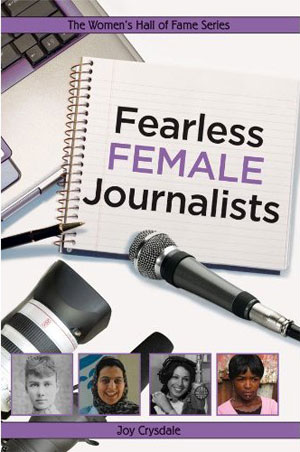
Fearless Female Journalists

By Joy Crysdale
Second Story Press

Fearless Female Journalists is a set of ten short profiles of female reporters, photojournalists, and newscasters hailing from various times and places over the last two centuries.

Among the women featured is one of the early pioneers of modern journalism: nineteenth-century American newspaperwoman Nellie Bly, a daredevil stunt reporter. Nelly Bly is perhaps most famous for circumnavigating the globe in seventy-three days in an era before airplanes, but she also took on assignments designed to do good as well as to make a splash. For example, she got herself admitted as a patient to the Women's Lunatic Asylum on Blackwell's Island in order to expose the terrible conditions there. In a later chapter, we meet Anna Politkovskaya, a Russian reporter who, despite her privileged origins as the daughter of diplomats, made the decision to risk–and ultimately lose–her life in order to report on the Russian occupation of Chechnya. (Politkovskaya was assassinated on October 7, 2006, at age forty-eight.) The book closes with a portrait of Thembi Ngubane, a young South African woman who recorded an audio journal about her life with AIDS as part of an effort to end the stigma around AIDS, as well as to push the South African government to acknowledge the tragic proportions of the AIDS epidemic.

The book is geared towards children–I estimate that it is most appropriate for an audience aged seven to eleven. The profiles are attractive and highly readable, complete with photographs and sidebars containing “fun facts.” The stories are entertaining and inspiring, and the selection of featured journalists reflects some variety in terms of era, type of journalism, and nationality (although the book still skews heavily toward heterosexual North American white women). Unfortunately, the book does have a downside–it is written from a “nice, liberal” standpoint, in which history is presented as an inexorable march towards progress, driven by a few exceptionally determined actors. This perspective glorifies individual high-profile “heroines” while erasing the history of communal struggle. It also obscures the reality that, in most cases, the few exceptional people who “make it big” do so not because they are more courageous or determined than thousands of others, but rather because they got lucky or started out with some “extras,” such as racial or class privilege.

The book reaches its nadir at the beginning of the final chapter, when it begins the profile of Thembi Ngubane by blatantly exoticizing her ethnicity: “Thembi Ngubane had a beautiful voice. Like her name, it was wonderfully African. Her voice flowed and lilted and swam around words, especially words with ‘r’ in them."

While I enjoyed reading Fearless Female Journalists and learning about the ten outstanding women profiled within, I could have happily done without the book’s uncritical, unconscious approach to the narrative of history and social change.

Review by Ri J. Turner

M.I.A. - /\/\/\Y/\ (Maya)

Interscope Records


A week prior to its July 13th release, M.I.A.’s new album, /\/\/\Y/\ (or Maya), was made available streaming on the artist's MySpace page. The agitprop-meets-cyberpunk video for “Born Free” is the most inspiring thing I’ve seen all year (a clear indication that M.I.A.’s message is as much visual as it is aural), and my guess was that her latest effort would be the most overtly conceptual album that M.I.A. has recorded.

The first track, "The Message," begins with the sound of keyboard strokes that reminded me of early alternative rock heroes R.E.M. and experimental musician John Cage. It creates a rhythmic paranoid beat laid over a mechanical nursery rhyme. A male voice suggests that the body is no longer private property, and spells it out for the “connected” listener: “Headbone connects to the headphone/Headphones connect to the iPhone/iPhone connected to the internet/Connected to the Google/Connected to the government.”

“Steppin Up” will appeal to fans of Kala. It mixes laser and power drill sound effects with a melodic reggae pace while asserting an increasingly cyborgian identity. “Teqkilla” recalls “Boyz” for its hyperactive layers of hip-hop hooks and fluctuating vocals. This is a sexy club song, and would be the closest that M.I.A. settles into mood music.

Although she is stretching choruses and pressing the temporal limits of pop music, M.I.A. still has a knack for constructing tighter melodies, and proves it on “XXXO.” This track is about unrequited love, and calls a potential lover out for his down-low tweets. It’s a beat-heavy examination of familiar odes to obsessive love.

/\/\/\Y/\ is definitely weirder than M.I.A.'s previous recordings, and it will be interesting to see where critics of her ability to balance political and aesthetic ambitions go with this album. Will the media continue to castigate M.I.A. for going too far beyond the pop star galaxy with her overt political agenda? If so, I just hope M.I.A. doesn't go the way of pop feminist icon Madonna and, in the words of bell hooks, "return to patriarchy."

Review by Maria Guzman

Cross-posted at Gender Across Borders

The Tyranny of Opinion: Honor in the Construction of the Mexican Public Sphere

By Pablo Piccato
Duke University Press

A coworker who saw this book sitting on my desk commented, “The tyranny of opinion? Isn’t the whole point of an opinion that it’s free from tyranny?” Not quite. Even today, public opinion can make or break a celebrity’s or politician’s career. In The Tyranny of Opinion, Pablo Piccato weaves an intricate web connecting a variety of aspects of nineteenth century Mexican society, examining the notion of how honor was closely tied to one’s place in society and how public opinion affected people’s public and private lives.

Since honor was one of the most important—if not the most important—form of social capital one could have, people went to great lengths to maintain (or attain) it. Journalists at the time, for example, had a dualistic connection to public opinion. On one hand, they were responsible for publishing the material that helped create it. On the other, many journalists were underpaid and worked in poor conditions, and their upward mobility in society was closely tied to their success as writers. As such, establishing one’s reputation sometimes took precedence over objective reporting, which in turn had an impact on how public opinion was shaped.

Love affairs, student protests, public riots, and duels are also subjects of analysis in the book. Lest one think that he focused solely on the honor of the upper class, Piccato actually covers a broad spectrum of race and class. He is also careful to include a gender-based component in his analysis. Although the book focuses largely on the honor of men, Piccato examines the reasons why women—especially “respectable” women—were largely excluded from public life. In his conclusion, he notes how his analysis regarding women, domesticity, political narratives, and moral economy serve to contribute to a larger academic conversation about these subjects.

Piccato grounds his work in close readings of primary sources, interpreting everything from published newspaper stories to court documents. His knowledge of the historiography on the subject is evident, as is his knowledge of Mexican culture during the late eighteenth to early twentieth centuries. The strength of the book lies in Piccato’s ability to convey the context of his analysis. The Tyranny of Opinion will surely serve as an excellence resource for Mexican history scholars.

Review by Melissa Arjona

Peepli Live

Directed by Anusha Rizvi
UTV Motion Pictures

The women of Peepli… well, there are no women in Peepli. Yes, there are daughters and mothers and wives, and to them Natha is purportedly “son and brother.” Natha is in dire straits; he has taken a loan from the bank and now cannot repay it. In an attempt to keep their lands from being auctioned off, Natha and his brother, Budhia, go to the local strongman cum political candidate for advice.

The politician recommends that one of the brothers commit suicide, for while the government does not provide debt relief or agricultural subsidies for farmers, it will give a sizable payout to the family of a farmer who has committed suicide. And therein lays their salvation. The family will have money and what have the two brothers done with their lives anyway? Let one sacrifice himself for the greater good.

Natha is a simpleton and his somewhat more savvy brother convinces him that since Budhia is the one who has a family, Natha must be the one to commit suicide—only he can save them all. Obligingly, Natha agrees. Later on that evening, after the brothers have drunk themselves into a stupor, a visiting reporter hears their story. The following morning’s headline foretells the death of farmer Natha and a media circus (as well as a political one) descends onto Peepli. The various parties and partisans push and pull, and attempt to decide whether or not Natha should live.

The three female characters in the film are all shrews. From Natha’s wife, who badgers and assaults the brothers, to his mother who complains and swears, to the reporter who appears to be unconscionably chasing leads, there is not a single positive female figure in the film. Inflation herself is a witch, wreaking havoc and ruining the farmers’ lives, leading them to their early graves.

Review by Elisheva Zakheim

For My Father

Directed by Dror Zahavi
Israfilm/Relevant F!lm


Centering on the chaste love affair between a Palestinian and an Israeli, For My Father offers the viewer a Middle Eastern re-telling of Romeo and Juliet while trying to spell out the complexities of post-intifada Israel.

The film opens up on Tarek (Shredi Jabarin), a Palestinian who has decided to act as suicide bomber. He’s ambivalent about the state of Israel—as well as Palestinian resistance to it—but takes action in order to salvage his yet-unseen father’s sullied reputation. After unsuccessfully trying to set off his bomb, he realizes that the device fails due to faulty wiring in the detonator, a jerry-rigged switch. Panicking, he flees, ending up in one of the scruffier areas of Tel Aviv. He ducks into an electronic repair shop, encountering Katz (Schlomo Vishinsky), an elderly Romanian Jew with a chip on his shoulder and a leaky roof. Tarek agrees to fix the hole in Katz’s roof in exchange for a new switch, which has to be ordered. As Shabbat is celebrated the next day, Katz’s shop will be closed until Sunday. Tarek is then forced to spend the weekend with the very people he was planning to kill.

During his sojourn, he interrupts the half-hearted suicide attempt of Mrs. Katz. He also befriends Keren (Hili Yalon), a beautiful tough-cookie who has fled her Orthodox Jewish community after an out-of-wedlock pregnancy. After saving her from a group of Orthodox toughs who object to her independent living and emo clothing, the two spend most of the following two days together, enjoying an easy rapport. Tarek rediscovers a passion for life which deepens his ambivalence about his mission. The fact that his handlers can detonate the bomb with a cell phone—and have threatened to harm his parents—only intensifies Tarek’s dilemma.

Yes, the movie did have its manipulative moments and the director unquestionably downplays the hostilities between Arabs and Jews in Israel. (The “Death to Arabs” graffiti scribbled on a building seemed downright contrived.) I found it odd that the Israeli characters never once questioned the very noticeable lump under Tarek’s clothes. For that matter, Keren and the Katzes seem too accepting of Tarek’s explanation for his very presence in Tel Aviv, a city that has kept Palestinians out via roadblocks for years. I also found myself questioning whether Israelis as a group are as averse to racial profiling as the Katzes and Keren are, and if the decision to paint Shaul, the one Jew who does express suspicion of Tarek, as a pompous buffoon wasn’t a subtle form of self-congratulation on the part of the Israeli director and screenwriters. I couldn’t help but wonder about how a Palestinian filmmaker would have approached this tale—or if a Palestinian would have chosen to tell this particular story at all.

In all fairness, however, this film wasn’t about the politics of the Israeli-Palestinian conflict. This film is basically a movie about outcasts and how they often instinctively seek out and cling to other outcasts, battling loneliness while skirting the edges of society. For My Father also touches on the very human need to maintain reputation with the emotionally fraught bond between parents and children driving the story in surprising ways. I appreciated the fact that the story doesn’t insult the audience with a tacked-on happy-ending; there’s no way that a movie with a terrorist as leading man can end on an emotional high note.

Despite its over-idealized view of ethnic strife and pseudo-philosophical leanings, I am going to recommend For My Father on the strengths of its understated and powerful performances. But anyone expecting to get a crash course on the current state of Israeli-Palestinian resentments needs to look elsewhere.

Review by Ebony Edwards-Ellis

Made in Pakistan

Directed by Nasir Khan
Talking Filmain


These days, political analysts on both sides of the aisle are calling Pakistan a failed state. While the “most dangerous place in the world” does face profound political and social turmoil, such sweeping commentary fails to capture the more personal intricacies of the lives of ordinary people living inside the country’s borders. Pakistan is more than the Taliban fighters implementing Sharia law in the Swat Valley, and it’s more than the frequent bombings of embassies and hotels from Islamabad to Karachi. As a way of countering the predominant fundamentalist image of Pakistanis constructed by the global media, filmmaker Nasir Khan recently released a poignant documentary that defies stereotypes and sheds light on some of the common challenges faced by citizens with lofty and patriotic ambitions.

Made in Pakistan presents the way a new generation of young leaders negotiates the conflicting pulls of consumerism, family, politics, gender, religion, and traditionalism. The film follows four educated, upper middle class, young Pakistanis in Lahore—a working mother, a lawyer, an event/PR manager, and a politician—from General Pervez Musharraf’s declaration of a state of emergency and military takeover in November 2007 to former Prime Minister Benazir Bhutto’s assassination in January 2008. Waleed Khalid is a lawyer and professor at the Pakistan College of Law. He is a devout, but not uncritical, Muslim who has joined others employed in the judicial system to protest government corruption, in part fueled by American aid. In addition to raising her son, Rabia Aamir is the editor of The Fourth Article, a newly established magazine by and for politically savvy Pakistani youth. Aamir is a cultural activist who wants to find solutions to the political, social, and spiritual upheaval in the country. These two characters were the ones with whom I felt most sympathetic.

On the other hand, we have Tara Mahmood, a girl for whom the whole world is one big party waiting to happen, and she’s the one organizing it. Tara provides a lot of comic relief to an otherwise weighty film (at one point she says, "Alcohol is not banned here; it is just not legally sold."), and I was particularly moved when finally given the chance to see beyond her bubbly veneer. By contrast, duplicitous politician Mohsin Warraich provides an ominous, slimy representation of modern Pakistan: The film doesn’t have an outright villain, but if it did he’s be the one. Made in Pakistan is a compelling view of the immense contradictions of modern Pakistani society.

Review by Mandy Van Deven

Originally published in Bitch Magazine

Robin Hood

Directed by Ridley Scott
Universal Pictures


Being the rabid Ridley Scott fan that I am, last week I went to go see his new movie, Robin Hood, at the theatre. (Being the cheapskate that I am, I went in the morning and paid four dollars less than going at night, because really, ten dollars to see a movie is ridiculous.)

Robin Hood isn't Kingdom of Heaven, let's start with that. I know a lot of reviewers, myself included, went in thinking it would be much of the same material, and it wasn't... to a point. Robin Hood takes place about nine years after the events in Kingdom of Heaven, close to the end of Richard's wars in France, which come to an unforeseen halt when Richard dies. The main character, Robin Longstride, is an average man in the ranks of Richard's army, pulled to the king's attention when Richard, on a whim, goes through the camp looking for "an honest man." Scott set out to retell Robin Hood, and in that he succeeded. And while he was doing it, he took a lot of the fun out of the Robin Hood story and inserted a lot of politics.

I think the big draw of Robin Hood is that he's a man who exists outside of political interests, or if he is involved, his intentions are always very clear: he's King Richard's man, he supports Richard's causes, and he supports the people. Simple and easy to remember. Scott's Hood should be simple, but instead comes off as much more complicated and politically embroiled than a character who, up until a half hour into the movie, was just a common archer. He expresses himself much better than a common man would have. That's kind of a theme in Scott's movies, which Balian somehow got away with, but Robin's high-handed speeches just sound dull.

What's interesting about this movie is the extremely mixed response it got throughout the reviewing world. Most people disliked it, and I can see why. Two sources that liked it a little more than the rest, however, interested me. One major feminist blog reviewed it with evident enthusiasm, the writer reporting that she loved the strong female lead offered by Cate Blanchett (appropriate sentiments for a feminist blog) and the revolutionary aspects of the idea that you didn't have to be a noble to speak up an affect change in a society.

The other interesting review is from the National Catholic Register, which is the only weekly paper my house now receives. Their film critic, Steven Greydanus, said it was "more watchable in most respects" than Kingdom of Heaven (a statement I'd like to vehemently disagree with) and judged that "the moral issues [were] less muddled, the hero more compelling, the heroine more relevant, and the romance at least relatable, if not especially engaging."

As much as I love Blanchett and the idea of a feminist Marian, that was one of the elements in the movie that didn't sit well with me. Both critics bring it up as something to be praised in Scott's epic, and I'm going to have to disagree. Kingdom of Heaven had a strong female lead in Princess Sybilla, a woman who was interesting because she was hard to understand at times and remarkably transparent in others. Sybilla made sense in the context of her story; for part of her life she had been a political pawn and needed to continue being a political pawn (something that went against her personality) if she wanted to see her kingdom survive.

Marion, on the other hand, makes less sense. Even if her husband had been gone with Richard for ten years, the idea that she would have become this Amazonian leadership lady in that time didn't seem possible in England circa 1200. Is she more relatable? Yes, more people could probably relate to Marion than they could to Sybilla. That doesn't necessarily mean she belonged in the story. A woman taking up a sword at the end of the film? It doesn't even begin to make sense. The feminist element in Robin Hood contributes just as much to the revisionist view of history that Greydanus (rightfully) accuses Scott of as any of the other wildly inaccurate historical elements in the film.

As I tried to figure out how to write this review, I attempted to find some lesson I could take away from the different ways these different people reviewed this film. Anna watched it as a feminist and found something she liked. Steven watched it as a Catholic and found it lacking. As for myself, watching the film as both a Catholic and a feminist (as well as a lot of other things), I found my lens as an amateur historian taking more and more of my attention away from the others.

I won't claim that I took note of all the inaccuracies in Robin Hood, and I'll certainly admit to ignoring some of the revisionist elements in Kingdom of Heaven. Both movies inspired me to do more research on the period in question. I have four books from the library on William Marshall and a growing collection of literature on what life was like in Europe and the Latin East in the 1100s. To me, the idea that a piece of media can be a gateway into a wider world of fact checking and research is a valuable one, and one that is helping me find the joyful Middle Ages behind Hollywood's "faux-realist medieval world," the real links of mutual respect between the Muslim world and the Christian one, and the real proto-feminist figures in the medieval history (women like Eleanor of Aquitaine, Hildegarden of Bingen, and Queen Melisande of Jerusalem).

Overall, I'd recommend avoiding the admission price (however low) at the theater and waiting for the DVD if you were thinking of going to see Robin Hood. In the meantime, you're welcome to join me in reading Warriors of God by James Reston and Four Queens by Nancy Goldstone for a more historically accurate look at the the Crusades and women in the middle ages.

And if you must have your ridiculous but fantastic crusades, there's always the other Scott named Walter.

Review by Mercury Gray

Cross-posted at The Village Wordsmithy

A Decade of Negative Thinking: Essays on Arts, Politics, and Daily Life

By Mira Schor
Duke University Press

A Decade of Negative Thinking is a collection of essays on feminism, paintings, and feminist art history. As a teacher of graduate students, Schor’s experience provides us with practical and theoretical background to an artist’s commitment to contemporary art.

The main theme of the study encompasses the ideas and images from Schor’s earlier life that were significant in influencing her artistic direction. The underlying theme explores the ways in which the past is perceived either consciously or subconsciously by people, and how easily it is to be misguided when forming our current views and opinions because of the undue influence of past styles. The artist writes as a New Yorker because she considers this city to be the center of the world art market, and an inspiring place from which to observe contemporary art and culture.

In part one, "She Said, She Said: Feminist Debates, 1971-2009," Schor describes debates on feminism and feminist art in a number of symposia, art magazine forums, and conferences over the years. Initially, as one of the chapter titles states, "The –ism Did Not Dare Speak Its Name" refers to the many academic –isms theories such as modernism, postmodernism, feminism, and post-structuralism. But later in “Generation 2.5,” the focus is on a community of women artists who had ideals about the feminist art movement, and who followed their direction during difficult times. They challenged the notion of a canon in art production and the cult of celebrity in contemporary culture.

In part two, "Painting," Schor analyzes the production of art history from a feminist perspective. She concentrates on the works of Alica Neel, an abstract painter who created Two Girls. Spanish Harlem (1959), Dore Ashton (1952), and Self Portrait (1980). She also considers works by Lisa Yuskavage and Myron Stout.

In part three, "Trite Tropes," Schor presents her views on common themes in art that are popular among college students and practitioners of the avant garde academy. Schor claims that art education is inadequate or even non-existent. She also asserts that practical visual contact by students with the artists themselves would help to clarify some misconceptions on art. As the writer explains, “negative thinking may indicate more of a programmatic belief in modernist ideas of resistance via that methodology of negative dialectics than is actually in play.”

Schor would like to see art works discussed and analyzed even if that analysis may be negative from the point of view of the art market. She clearly believes in the power of art despite all odds. This hope can empower our thinking and our actions. Schor vigorously researched her topic and included visual images of paintings in her book, which contributed to the visual pleasure of her narrative. I found her essays engaging and appealing, mostly because of Schor’s anecdotes and the choice of her personal stories; however, I needed a few breaks in the reading of her theoretical background, as some of the essays require extreme concentration on the part of the reader.

Overall, Schor, who is also a painter and writer, creates a very witty, brave, carefully designed, in-depth study on the question of politics and aesthetics in the contemporary world.

Review by Anna Hamling

Everyday Nationalism: Women of the Hindu Right in India

By Kalyani Devaki Menon
University of Pennsylvania Press

Everyday Nationalism, a publication in "The Ethnography of Political Violence" series, offers readers a provocative and sometimes disturbing look at Hindu nationalist organizations and the role of Indian women in representing the nationalist movement. Kalyani Devaki Menon conducted her principal fieldwork in and around Delhi from January 1999 to January 2000, acting as a participant observer; interviewing women activists; visiting schools and training camps associated with the movement; and taking part in women's education classes, meetings, rallies, and protest marches. She reports that “gender and sexuality were pivotal to the narratives of self and 'other' produced by the women” she worked with, and that women played a crucial role in building the broad-based support for the movement that brought the Bharatiya Janata Party (BJP) into power from 1998 to 2004.

The nationalist movement in India remains powerful, drawing thousands of women and men to accept a sociopolitical vision that is “xenophobic, exclusionary, and tremendously violent,” a view of India that sees Muslims and Christians as invaders, defilers both of Hindu women and the sacred soil itself, the body of the goddess Bharat Mata (Mother India). Hindu nationalists assert the need for “violent reclamations of Hindu masculinity” and for vengeance on outsiders who have violated the honor of Hindu women. Menon asserts, "This gendered construction of history, that perpetuates the logic of revenge, is widely promulgated to young female recruits, and remains central to mobilizing support for the politics and actions of the movement today." She makes clear to readers that she disagrees with this policy, yet she does not comment directly on the horrible irony of a politic that encourages Hindu youth to rape Muslim women and Christian nuns as payback for the sexual assaults said to have been enacted on Hindu women now and in the past.

The image of women as vulnerable victims is somewhat offset within the movement's various organizations by efforts to strengthen and toughen girls and women. Camp sessions include military drill, endurance training, yoga, and rough physical games. Women are taught to overcome their fears and to defend themselves. One woman activist said, “Girls today want to be free. We ask them, do you want to be free or strong?” Hindu nationalists criticize the desire to be free like Western or feminist women, claiming Indian women should be strong in order to serve the Hindu state, but still subservient to their husbands and male leaders. In Hindu societies, women are traditionally seen as “mothers, wives, and caretakers of their families.” Nationalists consider the whole Hindu nation to be an extended family, and in this context, women find reasons for civic activism: they become, in a sense, mothers of the nation.

Most Indian women marry, and many Hindu women nationalists are married, but many activists in the movement are either female renouncers; religious sadhvis, who give up worldly attachments but remain political; or pracharikas, unmarried celibate female volunteers who devote all their energies to the movement. A number of other women activists are widows or separated from their husbands. In a sense, the political organizations to which they belong become their families. Women find a favorite role model in a historical figure, Queen Jijabai, mother of the Hindu king Shivaji in the seventeenth century. Male historians concentrate on Shivaji himself, but the women nationalists portray Jijabai as an “enlightened mother” who played a key role in the nation's destiny by inculcating Hindu values in her son.

Menon's witness is compelling because she acts as intermediary between the people she studies and her readers, who need to understand what's going on in the crucial Indian subcontinent. Just as she translates Hindi texts into English, she explains many customs and beliefs that may be unfamiliar to non-Hindus. I found her presentation enormously helpful and would recommend Everyday Nationalism to anyone interested in religious movements, rightist politics, or both.

Review by Kittye Delle Robbins-Herring

Visibly Muslim: Fashion, Politics, Faith

By Emma Tarlo
Berg Publishers

In her new book, entitled Visibly Muslim: Fashion, Politics, Faith, Emma Tarlo captures the diversity in the way that Islam is practiced against the backdrop of multicultural Britain. Refreshingly, the book did not aim to answer whether or not covering was a part of Islam, and neither did it represent the views of Muslim women as a monolithic body.

In her book, Tarlo shows a snapshot of the way in which the veil has manifested itself within the Muslim population of Britain. In focusing on the way that different Muslim women struggle to find common ground between various identities, and the reactions of those around them, Tarlo looks at the veil as a part of the changing dynamics of members of a newer community, rather than an exposé that aims to penetrate the “secret world of Muslim women.”

Within the book, Tarlo moves from discussing high-profile Muslim women, to fashion, the hijab as a part of politics, and the fluid relationship between culture and religion. She does not gloss over the difficulties in finding a bridge between identities. When I saw the words “fashion” and “veil” together, I was worried that I would be confronted with a piece that would merely wax poetic about the intricate embroidery of hijab and the wonderful colors and trends that are starting to rival the Western fashion industry. Tarlo does depict changing fashions for Muslim women, but rather as a part of personal journeys. Furthermore, she analyzes the discourse surrounding the emerging market for “modest fashion.”

The most hard-hitting theme of the book was that of integration. In writing about some of the challenges faced by Muslim women within British communities, I could definitely relate. While Tarlo introduced a great deal of personal narratives from a wide range of women, she also brought into play some of the debate surrounding the hijab within the Muslim community itself. Finding a sense of identity and purpose is a concept which most people–not just Muslims–can relate to.

What was refreshing was that she did not glorify or vilify groups that were more “modern” than others, but simply left the reader to try to understand the realities of grasping for a sense of identity. In showing this theme of integration as a part of juggling different identities, rather than a poisonous and foreign part of society, it forced me to really reflect on how difficult it is for anyone to try to fit in on any level. Rather than trying to promote an “acceptable” level of integration, Tarlo merely provides a picture of the realities of the Muslim community in Britain. This is significant because she does not depict it as a threat, but rather as important debate that shows that the face of Islam is changing and growing, as with many immigrant communities.

What I felt was monumentally missing from Tarlo’s work was the voice of Muslim women who have either been forced to veil or took it off. While she did a great job in showing the diversity of religious views and coming to the veil, I think that in analyzing the world of hijab, it is important to understand why women may reject it entirely. Also, I felt that she could have analyzed the role of socioeconomic status a bit more within the book. While the role of fashion is very significant in trying to understand the identities of Muslim women, I felt that fashion may have a different place and even the hijab itself may play a different role for someone that may not be able to afford the diversity in dress.

Despite being left with these questions, overall I was impressed with the book’s fluid style, beautiful pictures, and honest stories. Furthermore, I enjoyed Tarlo’s dedication to trying to capture not only a snapshot of the Muslim community within Britain, but also in trying to introduce the difficulties within the Islamic community itself. She does not glorify the hijab or Islam, but rather highlights the realities faced by Muslim women.

Review by Sara Yasin

Cross-posted from Muslimah Media Watch

HOPE - OBAMA - The Musical ?

I think it would be a great idea to combine American politics with American Idol

Well either way if you will be in Frankfort, Germany later this month,it may be worth it because reguardless of politics these guys can sing !

THE NILES LESH PROJECT - All Rights Reserved 2009
Join the network of NILES LESH / MIENFOKS pseudo-friends !