Showing posts with label young adult. Show all posts

Mockingjay

By Suzanne Collins
Scholastic Press

Mockingjay has finally arrived to conclude the breathtaking trilogy that began in 2006 with the conclusively-titled The Hunger Games. And this time, things have changed. In global effect, for better or worse, the main characters are bringing the furious fight to the enemy’s doorstep, in an act of rousing rebellion. But do they prevail? Well, I can’t answer that.

In Mockingjay, Collins holds her own under external pressure to show the blunted faces of the worst brought out in humanity, but also the best of what makes us human, compatible life forces willing to love, to teach, and to learn in the shadows of dark times. What was merely a sadistic game of cat-and-mouse is now a battleground, a fledgling place where heroes are born and lives are lost. Every punch is pulled, which is not to say the first and second books didn't contain conflict, but things are now broadened on the horizon. The characters realize they have entered an alien place, a wildfire atmosphere only done justice by a single word: war.

What really propels this book is its characters, particularly Katniss, who fight for what they believe in and stand alongside those they love. Each play pivotal roles in supporting each other, and adds a unique back story, just when you thought everything was already revealed. Loyalties are tested and occasional twists paint a very thin line between good and evil, relishing in the fact that, as human beings, we are collections of both.

Any age can enjoy this book; however, the content is some of the most unwaveringly brutal and violent written work on the young adult market. Accusing The Hunger Games of glorifying violence is putting a very narrow perspective on things. The violence is there because it is necessary, willing to achieve a point by demonstrating the calculating monstrosities of war, warning readers about the implications of certain decisions, and feeling powerless to stop others of a higher social status.

The inclusion of strong female heroine give a sense of feminism to the book. At times, Katniss remained stricken, almost too conflicted, but it is a foreplay, a buildup to the explosive climax. She learns things about herself, growing as a person. It is the emotion, what we feel in our heart, not the misguided actions that make us for who we are. Everyone has a flaw, whether it be acid, spiders, or fear itself.

All the while, Collins maintains the pacing she keeps in the previous two. I was floored from the first page all to the way to the spectacular last. Small things are left unanswered, forcing the reader to come away from the experience to visualize, decoding what they think and understand.

By the time I finished, Mockingjay left me conflicted but satisfied, ruminating on the implications of what I read. Thankfully, it was a virtuoso performance I will not forget in a hurry. And not many books can do that. In a sense, young adult literature has some startlingly powerful messages to deliver, even branded for a younger generation. Older readers, and even fully-fledged adults, would find much to enjoy here.

Mockingjay delivers a stark limelight of the gratuitous impact of war on life, and examines the most powerful force on the planet through post-trauma, blood, tears, and the unbreakable substance of love. It is a masterful conclusion to an already groundbreaking series in young adult literature. If you haven’t experienced the raw potential for what The Hunger Games is all about, then I highly recommend doing so.

Review by Dan Goodman

Excerpted from Literary Musings

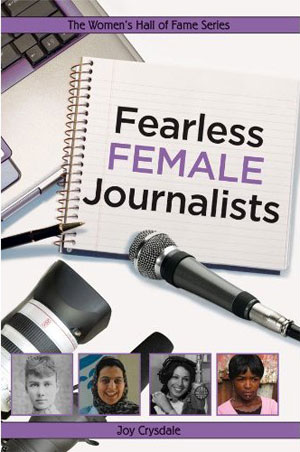
Fearless Female Journalists

By Joy Crysdale
Second Story Press

Fearless Female Journalists is a set of ten short profiles of female reporters, photojournalists, and newscasters hailing from various times and places over the last two centuries.

Among the women featured is one of the early pioneers of modern journalism: nineteenth-century American newspaperwoman Nellie Bly, a daredevil stunt reporter. Nelly Bly is perhaps most famous for circumnavigating the globe in seventy-three days in an era before airplanes, but she also took on assignments designed to do good as well as to make a splash. For example, she got herself admitted as a patient to the Women's Lunatic Asylum on Blackwell's Island in order to expose the terrible conditions there. In a later chapter, we meet Anna Politkovskaya, a Russian reporter who, despite her privileged origins as the daughter of diplomats, made the decision to risk–and ultimately lose–her life in order to report on the Russian occupation of Chechnya. (Politkovskaya was assassinated on October 7, 2006, at age forty-eight.) The book closes with a portrait of Thembi Ngubane, a young South African woman who recorded an audio journal about her life with AIDS as part of an effort to end the stigma around AIDS, as well as to push the South African government to acknowledge the tragic proportions of the AIDS epidemic.

The book is geared towards children–I estimate that it is most appropriate for an audience aged seven to eleven. The profiles are attractive and highly readable, complete with photographs and sidebars containing “fun facts.” The stories are entertaining and inspiring, and the selection of featured journalists reflects some variety in terms of era, type of journalism, and nationality (although the book still skews heavily toward heterosexual North American white women). Unfortunately, the book does have a downside–it is written from a “nice, liberal” standpoint, in which history is presented as an inexorable march towards progress, driven by a few exceptionally determined actors. This perspective glorifies individual high-profile “heroines” while erasing the history of communal struggle. It also obscures the reality that, in most cases, the few exceptional people who “make it big” do so not because they are more courageous or determined than thousands of others, but rather because they got lucky or started out with some “extras,” such as racial or class privilege.

The book reaches its nadir at the beginning of the final chapter, when it begins the profile of Thembi Ngubane by blatantly exoticizing her ethnicity: “Thembi Ngubane had a beautiful voice. Like her name, it was wonderfully African. Her voice flowed and lilted and swam around words, especially words with ‘r’ in them."

While I enjoyed reading Fearless Female Journalists and learning about the ten outstanding women profiled within, I could have happily done without the book’s uncritical, unconscious approach to the narrative of history and social change.

Review by Ri J. Turner

Claire de Lune

By Christine Johnson
Simon Pulse

Claire de Lune, Christine Johnson’s debut novel, is a good, but not standout, addition to werewolf lit. The simple way that this twist on werewolf lore is presented will make it a quick and satisfying read to ardent werewolf lovers, though it will have a tougher time winning the hearts of others.

In Claire de Lune, Johnson introduces us to a different type of paranormal world, in which only females can be werewolves. It’s not a feminist book, per se, but the dynamic that this sets up allows Claire to grow into a strong and self-reliant girl/werewolf. Here, it’s the girl protecting the boy, not the usual other way around.

Having a girl be the strength in a relationship would be a great story, but the book never fully lives up to its potential. Outside of Claire, I found the characters difficult to get to know, most of them only fitting roles expected to appear in a paranormal romance: the tensions among the werewolf group members, the love interest’s villainous father, the head-butting mother. I never found myself fully immersed in Claire’s family dynamics, with her mother’s Type A “bad parent” personality and their rather inconsequential au pair (who’s more a red herring than a useful character). All of Matthew’s father’s supposedly malevolent machinations and campaign against werewolves remained in the distant background and never fully took on immediacy.

I guess I’m just extra cynical when it comes to paranormal romances nowadays: it’s going to take a lot to make something stand out for me. Claire de Lune never reaches that point, but I have no doubt that it will find its audience as scores of werewolf lovers prowl the shelves for something equally supernatural and romantic after watching Twilight for the twenty-eighth time.

Review by Steph Su Reads

The Mockingbirds

By Daisy Whitney
Little, Brown Books for Young Readers

I don’t know how many times I can say a book is one of the best I’ve read this year and maintain any credibility; we’ve still got quite a few months left in 2010, so I guess we’ll find out. The thing is, I’m pretty convinced that this is a golden age for YA, and Daisy Whitney’s The Mockingbirds really is a phenomenal debut novel–one of the best I’ve read this year.

Last summer, I took a Children’s Lit class at Cal State University, Northridge. During the course of a discussion on censorship, which everyone was unanimously against initially, we began to question whether there were any topics that people would really consider off limits for YA or children’s lit. When students started to consider what they might not want their own children to read, people discovered that they all had boundaries, each person has some point at which they would be uncomfortable having a kid or teen read a book. For many people, that boundary was rape. Now, I acknowledge the right of any parent to determine what is acceptable for their own child to read, but of course that is extremely different from determining what other people’s children should be allowed to read. The fact is that, according to several studies I found, about forty percent of reported rape cases occurred to people under the age of eighteen. Rape happens to teens far too often, and they have a right to read about it.

In The Mockingbirds, Alex is raped after a drunken night out at a club. She wakes up the next morning in a boy’s room, naked, and discovers two condoms in the trashcan. The trouble is that Alex can barely remember anything that happened that night, but her friends know that she was in no condition to consent. Alex attends a progressive boarding school where punishment is rarely meted out because the school believes the students can do no wrong, but a group of students called the Mockingbirds serve as the school’s vigilante justice system, taking students’ punishments into their own hands. After Alex’s rape, the Mockingbirds become protectors, judges, and jurors. As the investigation and trial are underway, Alex begins to remember bits and pieces of what happened to her, and she knows that the sex was not consensual.

Whitney’s book, inspired by her own experience of being date raped in college, is vividly and powerfully written. I was on the verge of tears throughout most of it. This is not to say that the book didn’t have light moments, because there certainly are some, but the overall intensity and my amazement at what I was reading kept me pretty emotional. In addition to Whitney’s beautiful capturing of Alex’s feelings throughout the book, she also did an impressive job incorporating details from Harper Lee’s To Kill a Mockingbird, on which the school’s justice system is based. (However, those who haven’t read the classic will find that enough explanation is provided to understand everything in this book anyway. But they should still read Harper Lee’s book because it is truly one of the best of all time.) The book was clearly well researched all around, from the descriptions of the classical music Alex plays to Martin the science geek’s mini-lessons on bird intellect. Martin and the other supporting characters were also thoroughly fleshed out, each one with their own story that adds to the book’s strength.

The Mockingbirds shows readers that there can be consequences to stupid drunken behavior, but that if you are raped, you are still the victim and you still have options. It also portrays the importance of speaking out, because even if you will never be who you were before, you cannot let the rape eat away at you and define you forever. In Whitney’s book, Alex does not reach out to any authorities, but she still finds a support system within her school and makes it clear that you do not have to be alone. The novel is never preachy, nor does it stray into feminist manifesto, but it does lend a voice to those who often have difficulty finding their own. At the end of the book, Whitney shares some of her own story and provides resources for people who have experienced sexual assault.

Review by Melanie Goodman

Cross-posted at Reclusive Bibliophile

Girl Parts

By John M. Cusick
Candlewick Press

I almost wrote realistic fiction for the category on this book—and it's basically about robots. I know that's a weird start to a review, but that's how I felt about the book. This story is about the Internet age and how it's keeping people connected online... but totally separate in real life. One company decided that the way to cure alienation for the many boys who waste their days online was to create a girl for them! A really hot, really devoted girl.

At first, my feminist sense started going off when I heard the premise. I mean, all a boy wants is a chick to love him? Really? That's all it takes? Surely there's a lot of fallout from that whole idea. And that is what Girl Parts is about: the fallout for one guy and his Companion.

I felt a little better about the idea when all of the problems started showing themselves pertaining to the idea of a robot girlfriend. I'm still a little bothered that there's no dude for the girls who spend way too much time online. I mean, we all know those girls exist (I'm trying not to look in a mirror), so it's hard to believe this company decided to only make girls instead of both sexes. But that's just me, I guess.

One of the reasons Girl Parts feels like realistic fiction is that it deals mostly with relationships and how people create and maintain them. I really liked seeing how all of the different characters interacted with each other. You see each of them from several different viewpoints, which makes the whole thing fit together really well and gives a more complete view of the characters.

I wish Girl Parts were a little longer because I feel like there were some things that could have been hashed out a little more. You get a really unlikely friendship toward the end and I would have liked to see more of how that worked out.

Despite being labeled as Young Adult, I think the subject matter is described in enough detail that it shouldn't be read by middle grade kids. It's a bit too graphic for them. For lack of a more in depth explanation, there's a bit sexual content. Oh, and some drug use as well. Just FYI.

Review by Emily @ The Ninja Librarian

American Girl Magazine (May/June 2010)

American Girl Publishing

I recently reviewed New Moon Girls Magazine and was particularly impressed with the way it provides interesting and encouraging content to young girls without succumbing to the harmful media trends that can potentially harm their self-esteem. American Girl Magazine is another publication that appeals to girls without excessively highlighting gender stereotypes. You won’t find articles here on how to win a boy’s affection or properly apply makeup. Rather, American Girl focuses on a combination of real world issues, like relationships with friends and family, and fun features like recipes, craft ideas, and quizzes. This particular issue offers the following sections:

· Together Time—suggestions for activities to do with parents
· Rooms for You—how to jazz up your room to fit your personality, be it earthy, artistic or sporty
· Frosted Friends—recipes for baking and decorating cupcakes, complete with cupcake stickers
· Which Friend Are You? And: Save or Spend? Quizzes
· Small Stuff—tips for decorating your doll’s room
· Puzzle Palooza
· Puppy posters

The magazine also publishes quite a bit of content from its young readers. This issue alone features drawings, letters, recipes, and more from over fifty girls. In my opinion, this gives readers the feeling that they have a role in the creation of the magazine and that the things they mail in have a good shot at being included.

While some feminists might bristle at the “girly” aspects of the magazine such as the encouragement to bake, decorate rooms and hang up pictures of puppies, I do not believe that this undermines the positive potential of the magazine. Some young girls are just plain girly, and there’s nothing wrong with that so long as it’s by choice. American Girl does, however, forgo an unnatural focus on appearance, weight, or popularity. In this way, the magazine provides an excellent alternative to other publications that push agendas that are toxic to a young girl’s development.

Review by April D. Boland