Showing posts with label journalism. Show all posts

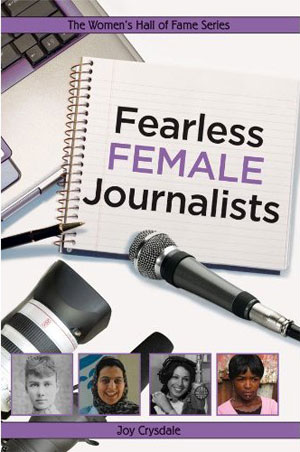
Fearless Female Journalists

By Joy Crysdale
Second Story Press

Fearless Female Journalists is a set of ten short profiles of female reporters, photojournalists, and newscasters hailing from various times and places over the last two centuries.

Among the women featured is one of the early pioneers of modern journalism: nineteenth-century American newspaperwoman Nellie Bly, a daredevil stunt reporter. Nelly Bly is perhaps most famous for circumnavigating the globe in seventy-three days in an era before airplanes, but she also took on assignments designed to do good as well as to make a splash. For example, she got herself admitted as a patient to the Women's Lunatic Asylum on Blackwell's Island in order to expose the terrible conditions there. In a later chapter, we meet Anna Politkovskaya, a Russian reporter who, despite her privileged origins as the daughter of diplomats, made the decision to risk–and ultimately lose–her life in order to report on the Russian occupation of Chechnya. (Politkovskaya was assassinated on October 7, 2006, at age forty-eight.) The book closes with a portrait of Thembi Ngubane, a young South African woman who recorded an audio journal about her life with AIDS as part of an effort to end the stigma around AIDS, as well as to push the South African government to acknowledge the tragic proportions of the AIDS epidemic.

The book is geared towards children–I estimate that it is most appropriate for an audience aged seven to eleven. The profiles are attractive and highly readable, complete with photographs and sidebars containing “fun facts.” The stories are entertaining and inspiring, and the selection of featured journalists reflects some variety in terms of era, type of journalism, and nationality (although the book still skews heavily toward heterosexual North American white women). Unfortunately, the book does have a downside–it is written from a “nice, liberal” standpoint, in which history is presented as an inexorable march towards progress, driven by a few exceptionally determined actors. This perspective glorifies individual high-profile “heroines” while erasing the history of communal struggle. It also obscures the reality that, in most cases, the few exceptional people who “make it big” do so not because they are more courageous or determined than thousands of others, but rather because they got lucky or started out with some “extras,” such as racial or class privilege.

The book reaches its nadir at the beginning of the final chapter, when it begins the profile of Thembi Ngubane by blatantly exoticizing her ethnicity: “Thembi Ngubane had a beautiful voice. Like her name, it was wonderfully African. Her voice flowed and lilted and swam around words, especially words with ‘r’ in them."

While I enjoyed reading Fearless Female Journalists and learning about the ten outstanding women profiled within, I could have happily done without the book’s uncritical, unconscious approach to the narrative of history and social change.

Review by Ri J. Turner

The Tyranny of Opinion: Honor in the Construction of the Mexican Public Sphere

By Pablo Piccato
Duke University Press

A coworker who saw this book sitting on my desk commented, “The tyranny of opinion? Isn’t the whole point of an opinion that it’s free from tyranny?” Not quite. Even today, public opinion can make or break a celebrity’s or politician’s career. In The Tyranny of Opinion, Pablo Piccato weaves an intricate web connecting a variety of aspects of nineteenth century Mexican society, examining the notion of how honor was closely tied to one’s place in society and how public opinion affected people’s public and private lives.

Since honor was one of the most important—if not the most important—form of social capital one could have, people went to great lengths to maintain (or attain) it. Journalists at the time, for example, had a dualistic connection to public opinion. On one hand, they were responsible for publishing the material that helped create it. On the other, many journalists were underpaid and worked in poor conditions, and their upward mobility in society was closely tied to their success as writers. As such, establishing one’s reputation sometimes took precedence over objective reporting, which in turn had an impact on how public opinion was shaped.

Love affairs, student protests, public riots, and duels are also subjects of analysis in the book. Lest one think that he focused solely on the honor of the upper class, Piccato actually covers a broad spectrum of race and class. He is also careful to include a gender-based component in his analysis. Although the book focuses largely on the honor of men, Piccato examines the reasons why women—especially “respectable” women—were largely excluded from public life. In his conclusion, he notes how his analysis regarding women, domesticity, political narratives, and moral economy serve to contribute to a larger academic conversation about these subjects.

Piccato grounds his work in close readings of primary sources, interpreting everything from published newspaper stories to court documents. His knowledge of the historiography on the subject is evident, as is his knowledge of Mexican culture during the late eighteenth to early twentieth centuries. The strength of the book lies in Piccato’s ability to convey the context of his analysis. The Tyranny of Opinion will surely serve as an excellence resource for Mexican history scholars.

Review by Melissa Arjona

Love Goes to Press: A Comedy in Three Acts

By Martha Gellhorn and Virginia Cowles
Edited by Sandra Spanier
Bison Books, University of Nebraska Press

It's impossible to dislike a female protagonist who opines, fifteen miles south of the Italian front in the second-to-last year of World War II, "If there's anything I really loathe, it's a woman protector." Delivered by Annabelle Jones, war correspondent for the San Francisco World, in conversation with Jane Mason, war correspondent for the New York Bulletin, this line refers to one of the many well-meaning men who are the butts of the jokes in the play Love Goes to Press.

Longtime friends as well as colleagues, Jones and Mason are globetrotting journalists chasing after war stories when both improbably show up in the same tiny press camp in Italy. There, amid refrains of, "No, I am not a nurse," any time one of them places an intra-military call, each of the two women pursue dangerously-won exclusive stories and navigate surprise romantic encounters, the latter portrayed as considerably more perilous than the former.

The mostly-journalist ensemble draws an easy comparison to His Girl Friday, released six years before Love Goes to Press first appeared on stage. By contrast, the play's pacing and gender commentary read as tersely contemporary, and its production history as relatively dismal. First performed in the summer of 1946, audiences in London packed theaters to see it, taking advantage of the small luxury of cheap tickets, and in co-author Martha Gellhorn's estimation, eager to laugh amid grief, rationing, wide-spread destruction, and exhaustion in the first year of peace after the war.

American audiences, however, did not crave such levity. After only four performances in New York in the first week of 1947 (where, Gellhorn further recounts, the cast was ecstatic to shop and eat as much as they could), the play folded then disappeared. American reviews from the time reflect a limited range of emotions running from irked boredom to disgust: either the veteran lady war reporters who authored the play couldn't get war quite "right," for all of their experience, or they simply had the bad taste to profane such a sacred subject in a three-act comedy. From the distance of sixty-three years—perhaps as cushy as the distance between New York drama critics of the '40s and the European theatre of war—this self-important response seems a bit comical.

Editor Sandra Spanier does a fine job, in this expanded edition of Love Goes to Press, of providing historical and literary context for the play, which did not see a first printing until 1995. Her biographical focus remains overwhelmingly on Gellhorn, whose sixty-year career was comprised of relentless war correspondence, as well as fiction and travel writing. Co-author Virginia Cowles is comparatively unknown, despite being an experienced war correspondent and prolific nonfiction writer herself. (Gellhorn and Cowles met when both women were reporting on the Spanish Civil War—Annabelle Jones and Jane Mason are based on them, respectively.) I

n addition to Spanier's description of rescuing perhaps the only extant copy of the play, and her recovery and reprinting of deleted sections of Gellhorn's war reporting from the Collier's archives, Gellhorn's original introduction to the 1995 edition may be the most enjoyable historical work here. Good-humored but pitiless, Gellhorn's recounting of the more hapless accomplishments of the play's authors, which included fleeing stunned from cries of "Author! Author!" at the close of the play's premier, is like an authorial bow on behalf of both herself and Cowles, albeit regrettably late.

Review by Kaja Katamay