make/shift is a satisfying thing. Describing itself as "feminisms in motion," it is a much-needed breath of fresh air for both our minds and our movement. Deep, political roots give way to a body of thought-provoking content and are topped with flexible branches of ideas, encouraging discourse and change. The magazine itself has full-color front and back covers. The entire inside is in black and white. It's heavy on text, and I like it that way. The layout is easy to read; no "continued on page seven" nonsense here. Pictures are scant, but clear and artful. There are advertisements, and as expected for a feminist magazine, they're not of the demeaning garden-variety like the ones we see in other magazines.
make/shift boasts quality content; empowering, thought-provoking, and provocative. I saw boatloads of grassroots activism and resources, along with essays, interviews, news stories, poetry, and reviews. The advice column is answered by Nomy Lamm, which is pretty sweet. Reading this magazine brought up a lot of thoughts and feelings I haven't experienced in years. I felt both educated and encouraged, as if they were saying, "You're capable of making a difference. Then, tell us about what you did!"
Most magazines make me feel like I need to change my body and my life in order to be happier and more accepted. Instead of stress and insecurity, I welcomed the empowerment. "Why Misogynists Make Great Informants" definitely struck a chord in me. It made me recall my earliest days of activism, the people I met and the situations I encountered. I was disappointed to experience sexism and homophobia in activist groups. After fervently waiting for so long to move away and meet "my own kind," such experiences made me feel as if nothing on Earth was definitive.
Nomy Lamm's advice to an assault survivor's question both educated and moved me. I was very happy to see a column about self-publishing poetry, and plan to send my writing to a few of the DIY publishers listed. (Cross your fingers for me, yes?) In a nutshell, every article made me see things a little differently or taught me something new. All magazines should aspire to have high-quality content like make/shift.
Despite only existing since March 2010 and operating wholly through the work of volunteers, UK Feminista organized "two days of feminist training, explaining, and gaining," a free event on feminist activism in London. Held at Amnesty UK, it was overbooked and a visible ninety-nine percent of the 350 registered attendees came. The most amazing feature of the event was that it provided genuinely fun and interesting talks for activism beginners and veterans alike.
The enormous strength of the first day of summer school was its focus on practice. The afternoon was split into workshops on different levels of involvement: from how to organize a Ladyfest to running effective campaigns, organizing demonstrations, and planning direct action. All the materials from the workshops will be available at the UK Feminista website in the coming days.
Simultaneously to the events, UK Feminista volunteers were tweeting, providing quote selections and links so well that I didn't feel the need to take many notes. Instead, I have an online record of what was being said under the #femschool hashtag on Twitter. It is a goldmine of news, information, and people!
What struck me about the event, aside from supreme organization, was the enthusiasm of everyone involved, organisers and participants alike. People were chatting away and forming new alliances all the time. There's no better feedback for an event than when people just don't want it to end.
The second day was a lot more opinion- and discussion-based, but great training was still being given. We learned how to use media and influence politicians, how to fundraise and include disabled people in campaigning, the importance of promoting diversity within feminist groups, and why is climate change a feminist issue. The two arguably biggest events of the day, however, were the opening and closing panels. The first was with Jess McCabe of The F-Word, Hannah Pool, and Kira Cochrane. All three talked about their experiences with the media, and all agreed that to be a female journalist takes more effort and more talent, but their examples showed it was possible, and important.
The closing panel, "Feminist Question Time" with Bidisha, Dr. Aisha Gill, Sunder Katwala, Karon Monaghan QC, and Julie Bindel, provoked a lot more controversy. Bindel said there was a lot of terrible anthropological research concerning women in the sex industry, and that they should not be treated as an anthropological field research group; she went so far as to say that if she had one bullet in a gun, it would not go for the pimp, but for the academic who's all into the sex industry. Bindel also said, "we make a lot of excuses for men to the point where we praise them for not being fuckheads," which made everyone laugh, but later someone angrily said that the men in the audience must feel very excluded in the current talk, to which both Bindel and Bidisha reacted heatedly.
Overall I am inclined to say this was the best summer school I ever attended. It was a really inspiring, great opportunity to learn, meet people, and acquire skills and information to proceed with conviction and fury.
By Jennifer Anne Boittin University of Nebraska Press
Interwar Paris conjures up images of romance and renewal. From the ashes and rubble of the First World War, families reunite and rebuild under what seemed to be the end of the most dire of circumstances. Unfortunately, Colonial Metropolis fails to capture this magic, and yet it is an extremely thoughtful and methodical review of the local primary source material available, and would serve as a very strong academic referral source.
The author, Jennifer Anne Boittin, has a clear passion for the subject matter and conveys this well through her enthusiastic descriptions of the characters of the period who populated the anti-colonialism and feminist movements. The problem, for me, stems from the fact that we never feel the interaction between these players. These characters never seem to weave together into the larger story of feminist and anti-colonial activism, the tale that Boittin is seemed so hopeful to tell at the outset of the book.
Boittin lifts directly from the historical record to bring a multitude of characters from this period to life, but none so well as that as Josephine Baker. Pages and pages are dedicated to bringing her tantalizing and mischievous performances to life. Imagine the dedication and zeal of Marina Abramović crossed with the free wheeling sexual spirit of Isadora Duncan. Who wouldn’t want to be warped back to the front row for that show of an old theater in Paris?
With these high sensory moments scattered throughout, readers catch glimpses of the time gone by that was advertised to them, but even the best of these moments failed to sustain me from page to page. Clearly, Boittin’s integrity to the historical record speaks to her virtues as an academic; it just doesn’t make for a particularly interesting read.
Bella Swan has never been a character I’ve related to. She’s frustratingly timid, overwhelmingly insecure, and apparently has no interests or hobbies aside from her obsession with Edward Cullen. Sure, she’s had her redeeming moments, and yes, it was Bella who saved Edward from exposing himself to the Volturi in New Moon. But it wasn’t until the final moments of Eclipse that Bella became someone I can respect, and even admire.
The Twilight Saga has been heralded by many as a positive step for women in Hollywood, primarily credited for its representation of the female gaze. While I find this argument both positive and necessary, it is also problematic because it operates around a binary understanding of gender; if men do something this way, women will flip it and do it the opposite way. Feminist research and scholarship aim to disrupt this way of thinking and urge us to seek alternatives by exploring the gray area. It is in this gray area that Eclipse offers the most feminist perspective of all the Twilight films yet.
Consider the term twilight as a useful analogy: the time between day and night that can’t be classified as either, but is rather a little of both. The same is true for Bella’s struggle throughout the series, and it is never more apparent than in Eclipse. She is human, but has never felt at home in that world. With Edward, and the Cullen Clan, she feels things she hasn’t felt before: real, strong, and capable. But as any card-carrying feminist knows, leaving your “natural” world, seeking alternatives, and disrupting the status quo is never easy, and never without doubt.
Unfortunately, for Bella, her doubt comes in the form of a warm-blooded, hot-bodied fella, her best friend Jacob. While most of the film, and nearly all the witty dialogue, focuses on the jealousy and tension between Edward and Jacob, in the end it is Bella who makes the choice. And as she articulates at the close of the film, her decision is not based on pleasing Edward or Jacob, or anyone else for that matter, but rather on fulfilling her own desires.
Cinematically, the film has found balance amid the Hollywood effect; Eclipse lacks the low budget kitsch of Twilight without falling victim to the highly dramatized vampire visuals, and indulgent makeup, of New Moon. Though it is full of action and violence, the filmmakers should be commended for opting away from blood and gore, and instead crystallizing the vampire skeletons so they shatter like glass.
There are quite a few threads of social commentary being made throughout the film that offer plenty of fodder for further analysis, primarily around issues of choice. The ongoing battle between the dark-skinned, warm-blooded Quileutes versus the cold, soulless White people is an easy analogy for colonization. But when Jacob is injured during battle, Dr. Cullen is not only allowed on the Rez, but genuinely thanked by the tribe. We also learn the sad and violent story of Rosalie’s turning, and are provided insight into her disdain for Bella. “None of us chose this,” she reminds her, offering a subtle but important acknowledgment of the privilege of choice, and the power of having one.
By Hiratsuka Raichō Translated by Teruko Craig Columbia University Press
In the beginning, woman was truly the sun. An authentic person. Now she is the moon, a wan and sickly moon, dependent on another, reflecting another’s brilliance. ... The time has come for us to recapture the sun hidden within us.
These lines launched Seitō, a women's literary journal, in 1911 Tokyo. Hiratsuka Raichō was one of the founders, and she poured her emotions into this opening editorial. Her essay gave voice to frustrations felt by women across the nation, and is now considered part of the canon of Japanese feminism.
In the Beginning, Woman Was the Sun is Raichō’s autobiography. Teruko Craig has translated the first half of a four volume set, with her own summary of the latter half of Raichō’s life. The book can best be described as a memoir, with more focus on experiences than facts.
Raichō did not intend to become a feminist icon. An atypical young girl, she went fishing with her father as a child, and later fought for permission to enroll in one of the few women’s colleges. Throughout her youth, Raichō squirmed under the oppressive dictates of school and family, conventions we would designate now as patriarchal, though she was not thinking in such terms.
Raichō was given a remarkable amount of freedom for a young woman. She walked alone to and from school and pursued her own activities. Passionate about attaining spiritual growth, she studied Zen for years. Her interest in literature came late, but when it did she began poring through the classics of European thought.
It was a male friend who urged her to found Seitō, "Bluestocking," a literary journal dedicated to fostering women writers. Raichō’s original drive was to inspire women to become their authentic selves. She did not think in terms of men and women, but of people who were denying themselves spiritually.
Raichō became a primary manager of the operation, with a team of other young women, and the magazine remained independent during the majority of its run from 1911 to 1916. Those involved were dubbed "New Women" by the newspapers, and their every action was scrutinized. The editorial team constantly walked the line between asserting their rights to act freely and avoiding the condemnation of society and the government, which banned several issues.
Raichō narrates her memoir in the voice of a confident woman, never apologizing nor boasting. I felt as though she was sitting near me, telling the story simply because I had asked to hear it. She explains her motivations, even when they are not quite what one might expect from a feminist icon. It was only later in her life that Raichō began to fight for the special rights and responsibilities women have as women, particularly as mothers. She describes this as a maturation of view.
Much time is spent on Raichō’s relationships with other writers. Though I was interested in the other women participating in Seitō, there were so many of them that they began to run together. I am sure that, to someone more familiar with the movers and shakers of Raichō’s time, the names will have more meaning, and these insights into their characters will be a gift. Craig points out that as an oral narrative, the text “tends to be repetitious and digressive,” but I rarely found this to be an issue except for these tangential stories.
The only thing missing is more of Raichō’s writings. The preeminent “In the beginning…” essay is only excerpted, allowing tantalizing glimpses into Raichō’s mind without allowing the reader to develop a sense of her full meaning. I feel it would have been helpful to have more of what appeared in Seitō as well. As such, In the Beginning, Woman Was the Sun is not a one-stop-shop for learning about Japanese feminism. There is a good sense of history and the larger changes in Japanese society at the time, but only in relation to Raichō and her projects. Her motivations and intentions are explained, but her work is not allowed to speak for itself. Nevertheless, the book sheds light on a time and a place that few would think of as progressive in terms of women’s rights.
“What’s the status of Le Tigre?” an eager—albeit slightly angst-ridden—fan asks Kathleen Hanna during the Q&A session after the screening of Le Tigre: On Tour. I, too, had been wondering the same question—because this band, who has proven so formative to women young and old everywhere, seems to exist only in our collective lesbo-feminist consciousness at the moment. For myself, in particular, I was introduced to Le Tigre’s music a year before they performed their final show in NYC, on 18 September 2005, so I never had the opportunity to witness their awesomeness in concert. Their existence to me, in other words, was always to me like a memory, an extant pastness that is real but not actual in that particular moment. I think their existence, for me, is kind of like how people understand Jesus or Santa Claus: he’s touched their hearts, and therefore he’s real… at least they think he’s real, but they’ve never actually seen him.
Which is why this documentary is so utterly amazing: the film, comprised of compiled concert and backstage footage from their final tour for the album This Island in 2004, and including more recent interviews with the trio—Johanna Fateman and JD Samson, in addition to Kathleen Hanna—is essential to the band’s continued existence in our collective lesbo-feminist consciousness. Seeing footage of live performances made me dance in my seat, and it brought tears to my eyes, particularly during the scene in which Hanna turns to Samson and gives her an acknowledging look—the “this is it” moment—of it being the last performance (“Deceptacon”) of their final show.
Director Kerthy Fix did a brilliant job creating this documentary in a way that proves attractive to all audiences: her attention to the trio of characters, and their feminist, queer ethics that embody the desire that each person be her “own lost hero,” as Hanna professes, speaks to everyone who wants to cultivate themselves as strong, powerful, and unique individuals. The documentary-as-archive is so crucial not only to preserving the band’s music, but also Le Tigre as a seminal part of the riot grrl movement, which has been built by the enterprising musical endeavors of the band collectively and separately, as each has her own individual pursuits.
Here we can think, of course, of Kathleen Hanna’s previous band, Bikini Kill, as the foundational component of this movement. And, as we Bikini Kill fans know so well, there is a scarcity of Bikini Kill footage out there—they existed before the explosion of the Interwebs, of the social media sites and blogs—so having this documentary is a welcomed addition to the steadily growing archive of the feminist and riot grrl movements.
Kudos to Fix for providing feminists young and old with this filmic insight into the iconic band—from Hanna’s deadpan explication of dressing room snack items (i.e., a bowl of fruit fit for the pope) to Fateman’s detailed vitamin regiment and Samson’s coming to terms with her Casanova status—and their raw lyrics and hot dance moves (“West Side Story meets Jazzercise,” to be precise).
Le Tigre: On Tour does not yet have a distributor; indeed, it’s still in the processing stages, pre-color correx and sound fix. Hopefully, by the end of the year, this film will be picked up and shown in theatres across the world for all the Le Tigre fans who, like me, long to connect with the band that filled their hearts and heads with sweetness and light.
A few weeks back, Sabrina Chap (born Chapadjiev) contacted me to see if I wanted to review her new album, Oompa! Never one to turn down a free meal from female musicians, I obliged and she mailed me a copy (with a handwritten letter, no less — thanks, Sabrina!). While the item was in transit, Kjerstin Johnson at Bitch reviewed it for B-Sides.
Having not heard Chap before, the article gave me a good idea of what I’d be listening to. The cabaret sensibility of “Never Been a Bad Girl” suggested The Dresden Dolls (though not Evelyn Evelyn’ssuper-problematic crip drag) on first listen, as well as Inara George and Jolie Holland in louder moments. The emphasis on classical and ragtime instrumentation also recalled Squirrel Nut Zippers’ dedication to jump blues, jazz, polka, and swing. Both the Zippers and beloved Austin mainstay White Ghost Shivers have cultivated antiquated aural aesthetics to undermine nostalgia with biting observations, sly asides, and at times bawdy lyrics about the realities of modern life. Finally, Chap also seems to share similar feminist camp sensibilities with fellow New York-based retro revisionists Ménage à Twang. I haven’t heard Chap on KOOP’s “What’s a Girl to Do” program, but I think she’d be a perfect fit.
I don’t offer these artists up to slight Chap as derivative, but rather to put her in a larger context of artists. I believe Chap’s talents stand up on their own. I’m also interested in pursuing her written work. She’s penned some plays and edited a zine called Cliterature. She also edited Live Through This, an anthology about women who use art to work through self-destructive tendencies. The book contains interviews from Nan Goldin, bell hooks, Inga Muscio, Kate Bornstein, Eileen Myles, and Annie Sprinkle. That’s a helluva dinner party.
Most of Oompa! charmed me. The songwriting is sharp, the melodies are catchy, and Chap’s band possesses the sort of musical precision that allows it to really swing. I especially liked the self-effacing opening track “Blueprint for Destruction,” idyllic “Carolina,” reflective “Illinois,” spunky “Never Been a Bad Girl,” and the uncertain but defiantly optimistic “Boat Song,” which closes the album. “Failed Waitress/Failed Astronaut” may rank as my favorite track, as it turns the all-too-relateable subject matter of being college educated yet maligned by limited career prospects into a fun little jig. The slinky “Idiom,” which documents a clandestine hook-up with a sexy female stranger, is a close second.
Unfortunately, there are two songs on Oompa! that I can do without. “Little White House” brings to mind the nuclear family idyll espoused in Little Shop of Horrors‘ “Somewhere That’s Green,” which feminist-minded pop stars like Paula Cole critiqued in “Where Have All the Cowboys Gone?” I’m of the mind that Chap is doing similar work here, as the minor key and stately pace suggest compromised expectations. However, much like I felt with “Cowboys,” it’s hard for me to not hear this song as being condescending to its subject.
I also cringe when I hear “Ze Paris Song,” a song about a tourist trying to fit in with her surroundings while eating baguettes and brie as she reflects on the tragic men who love her and eschews the Eiffel Tower. That Chap delivers it in a put-on accent doesn’t help matters. Much like “House,” I believe Chap is being critical here. The results just rub me the wrong way.
Yet despite those minor grievances, I’d still recommend Oompa! Give it a spin on the ol’ Victrola.
By Courtney E. Martin & J. Courtney Sullivan Seal Press
Seeking inspiration for a novel she was writing a few years ago, J. Courtney Sullivan sent an email to several friends asking them, “What was the moment that made you a feminist? Was there one person, event, book, or idea that made it happen?” The conversation that followed was so fruitful that she decided to keep it going, and Click: When We Knew We Were Feminists was born.
In Click, editors Courtney E. Martin and J. Courtney Sullivan present twenty-nine essays by young feminists from all walks of life with the intention “to collage together a picture of contemporary young feminists…to discover what it is that still brings a diversity of young people to try on the feminist label despite the obvious risks.” The collection they’ve compiled is inspiring, insightful, and funny in all the right places, and I had to resist the urge to shout, “Preach on!” as I read it.
The voices in Click are as strong as they are varied, and the themes that emerge—the desire to break boundaries and prove men wrong; the need to create a personal feminism that is different from our mothers’; the struggle to balance sexual empowerment with feminist strength; and the tension created by identifying as feminist and as a member of another minority group—offer something for everyone. I saw myself and every feminist I know in the pages of Click, and that speaks to how well Martin and Sullivan succeeded in fulfilling their mission with this book, even if very few of the pieces are actually about singular moments of realization.
Rather than try to sum up twenty-nine fabulous essays in what would doubtless become a superlong review, I’ll now share some of the themes and excerpts that spoke to me, just to give you a taste of what you can find. In “Not My Mother’s Hose,” Courtney E. Martin recalls meeting Jennifer Baumgardner (author of Manifesta, a book that changed my life and many others) and experiencing her “click” upon realizing that modern feminism means that women can be both smart and sexy. That fishnet stockings and high heels are just as acceptable and empowering as menswear slacks and practical shoes.
Click gave me an opportunity to think more deeply about the moments and experiences that helped me the define the feminism that I live daily, and it reminded me that women are not the only ones who suffer from constricting definitions of gender. The strict definition of masculinity is also responsible for many writers experiencing their click moments when they decided to prove the boys wrong and do something they were told they couldn’t do. For Elizabeth Chiles Shelburne, whose piece is titled “Killing in the Name Of,” it happened on her eleventh birthday, when she insisted on going hunting, an eleventh birthday tradition usually reserved for the boys in her family.
Other women in the collection write about click moments that were sparked by sports, abortion rights, and even Kurt Cobain’s death. Black and Latina feminists describe the struggle to take on the feminist label while maintaining their cultural identities and defending their choices to women who didn’t understand or agree. I appreciated something about every essay in this collection, and I relished the opportunity to spend time reflecting on my personal definition of feminism and the experiences that shaped it.
I went to the launch event for Catherine Redfern and Kristin Aune's book Reclaiming the F Word at The University Women's Club. When I signed up to the event on Facebook, I just assumed from the name that this was perhaps a part of the University of London and was expecting to just wander down the road from where I work and into a student union building. On closer examination (i.e. after some Googling) I discovered it is a private members club in Mayfair, and perhaps an unusual place to host a gathering of rowdy young feminists! Slightly pleased I'd worn a nice frock for the occasion, I set off from work to catch the tube to Green Park and finally meet a woman I've admired for a long time.
When I first discovered The F Word website in 2001, it was quite a revelation. Full of articles by young women on a variety of subjects from a feminist perspective, it satisfied my need for something intelligent and 'bite-sized' to read and also inspired me to write. I wrote seventeen feature and review articles for the site over the next couple of years (you'll find me listed as Lorraine Smith on the contributors page) and every one was sent to Catherine Redfern before publication. We never met, as I lived in Manchester at the time, but we chatted a bit via email and so I was a little bit sad to see her step down as editor in 2007. However, this was because she wanted more time to devote to writing a book with Kristin Aune and so I was keen to see the results of all her hard work.
Last night I got my hands on a copy and Catherine kindly signed it for me. Everyone in that room was there to celebrate the work Catherine and Kristin had done, but also to celebrate feminism. The mood was one of excitement, hope and optimism. Now the book is out there, we can all help to promote it and get the message across that feminism is not dead or outdated. After finally getting to say hello to Catherine, I caught up with Helen and Hannah and then, surprisingly for someone who is usually extremely shy in many social situations, I chatted to a lot of new people. People I've encountered online but had never met in person. People I admire.
I met Sarah Barnes who is the brains behind the fantastic Uplift Magazine. I said hello to Holly Combe who has written an outrageous number of articles for The F Word site over the years. I chatted to Suraya Sidhu Singh, editor of Filament Magazine, about the magazine and the lack of decent 'boylesque'. I said hi to Jess McCabe and promised to write for The F Word again soon. I even approached Laurie Penny and told her how much I enjoy reading her blog. I'd been discussing with Hannah earlier in the evening about how it was Laurie who helped me understand my privilege, so it was wonderful to be able to say hello in person... although the wine seemed to help me forget all the eloquent things I wanted to say!
I started reading the book on the train home and I'm really impressed so far. However, as I'm a notoriously slow reader, please don't wait for a review from me before you buy yourself a copy. Come on, join the gang. Let's reclaim the f-word!
Paula Kassell's Taking Women in New Directions is not what it sounds like. Rather than being stories about the women's movement in the '70s and '80s, it is primarily a collection of articles that Kassell wrote for the feminist newspaper, New Directions for Women (which she also co-founded and ran out of her own home for seven years). The newspaper was published from 1972-1993, and at its peak had a circulation of 65,000.
The articles themselves are in the form of newspaper clippings, one every page or two (for a total of sixty), and are accompanied by family and personal photos, all of which makes the ninety-seven-page book seem more like a scrapbook than a text. Other than the clippings and photos, there is an eight-page history of the newspaper, also written by Kassell; a couple of pieces about Kassell written by others, Kassell's feminist curriculum vita; and some correspondence between Kassell and an editor. The result is an odd mix of self-promotion and social history.
This doesn't mean that the book is without value. It functions well as a primary source of second wave feminist writing. Kassell always documented her sources and was careful to provide detailed information about the books and organizations she referred to. The articles, editorials, book reviews, and columns, which are presented chronologically, cover a wide range of feminist issues, from equal pay to reproductive rights. One thing that was interesting about reading the book was seeing how many of the issues Kassell wrote about are still not resolved today.
The publisher, Hudson House is a “vanity” press. I give Kassell credit for putting forth the effort to compile the contents, have the book published, and undertake book signings at the age of ninety-one. (The book was published in 2008.) The impression I got is that Kassell wanted to leave behind a testimonial to her work in the feminist movement, primarily, but not solely, in terms of her contributions to New Directions for Women. For example, one of the her accomplishments was to help persuade the New York Times to begin using the honorific “Ms.” (It was one of the last major newspapers to do so.) And she is justifiably proud of all the organizations she joined or helped to found over the years.
The strength of this book is that it shows how the personal life of one woman can contribute to the impact of an entire movement. It is a good answer to those who say that the feminist movement is no longer necessary because all of its goals have been met. And yet the things that have changed have been through the efforts of women like Paula Kassell.
Being the rabid Ridley Scott fan that I am, last week I went to go see his new movie, Robin Hood, at the theatre. (Being the cheapskate that I am, I went in the morning and paid four dollars less than going at night, because really, ten dollars to see a movie is ridiculous.)
Robin Hood isn't Kingdom of Heaven, let's start with that. I know a lot of reviewers, myself included, went in thinking it would be much of the same material, and it wasn't... to a point. Robin Hood takes place about nine years after the events in Kingdom of Heaven, close to the end of Richard's wars in France, which come to an unforeseen halt when Richard dies. The main character, Robin Longstride, is an average man in the ranks of Richard's army, pulled to the king's attention when Richard, on a whim, goes through the camp looking for "an honest man." Scott set out to retell Robin Hood, and in that he succeeded. And while he was doing it, he took a lot of the fun out of the Robin Hood story and inserted a lot of politics.
I think the big draw of Robin Hood is that he's a man who exists outside of political interests, or if he is involved, his intentions are always very clear: he's King Richard's man, he supports Richard's causes, and he supports the people. Simple and easy to remember. Scott's Hood should be simple, but instead comes off as much more complicated and politically embroiled than a character who, up until a half hour into the movie, was just a common archer. He expresses himself much better than a common man would have. That's kind of a theme in Scott's movies, which Balian somehow got away with, but Robin's high-handed speeches just sound dull.
What's interesting about this movie is the extremely mixed response it got throughout the reviewing world. Most people disliked it, and I can see why. Two sources that liked it a little more than the rest, however, interested me. One major feminist blog reviewed it with evident enthusiasm, the writer reporting that she loved the strong female lead offered by Cate Blanchett (appropriate sentiments for a feminist blog) and the revolutionary aspects of the idea that you didn't have to be a noble to speak up an affect change in a society.
The other interesting review is from the National Catholic Register, which is the only weekly paper my house now receives. Their film critic, Steven Greydanus, said it was "more watchable in most respects" than Kingdom of Heaven (a statement I'd like to vehemently disagree with) and judged that "the moral issues [were] less muddled, the hero more compelling, the heroine more relevant, and the romance at least relatable, if not especially engaging."
As much as I love Blanchett and the idea of a feminist Marian, that was one of the elements in the movie that didn't sit well with me. Both critics bring it up as something to be praised in Scott's epic, and I'm going to have to disagree. Kingdom of Heaven had a strong female lead in Princess Sybilla, a woman who was interesting because she was hard to understand at times and remarkably transparent in others. Sybilla made sense in the context of her story; for part of her life she had been a political pawn and needed to continue being a political pawn (something that went against her personality) if she wanted to see her kingdom survive.
Marion, on the other hand, makes less sense. Even if her husband had been gone with Richard for ten years, the idea that she would have become this Amazonian leadership lady in that time didn't seem possible in England circa 1200. Is she more relatable? Yes, more people could probably relate to Marion than they could to Sybilla. That doesn't necessarily mean she belonged in the story. A woman taking up a sword at the end of the film? It doesn't even begin to make sense. The feminist element in Robin Hood contributes just as much to the revisionist view of history that Greydanus (rightfully) accuses Scott of as any of the other wildly inaccurate historical elements in the film.
As I tried to figure out how to write this review, I attempted to find some lesson I could take away from the different ways these different people reviewed this film. Anna watched it as a feminist and found something she liked. Steven watched it as a Catholic and found it lacking. As for myself, watching the film as both a Catholic and a feminist (as well as a lot of other things), I found my lens as an amateur historian taking more and more of my attention away from the others.
I won't claim that I took note of all the inaccuracies in Robin Hood, and I'll certainly admit to ignoring some of the revisionist elements in Kingdom of Heaven. Both movies inspired me to do more research on the period in question. I have four books from the library on William Marshall and a growing collection of literature on what life was like in Europe and the Latin East in the 1100s. To me, the idea that a piece of media can be a gateway into a wider world of fact checking and research is a valuable one, and one that is helping me find the joyful Middle Ages behind Hollywood's "faux-realist medieval world," the real links of mutual respect between the Muslim world and the Christian one, and the real proto-feminist figures in the medieval history (women like Eleanor of Aquitaine, Hildegarden of Bingen, and Queen Melisande of Jerusalem).
Overall, I'd recommend avoiding the admission price (however low) at the theater and waiting for the DVD if you were thinking of going to see Robin Hood. In the meantime, you're welcome to join me in reading Warriors of God by James Reston and Four Queens by Nancy Goldstone for a more historically accurate look at the the Crusades and women in the middle ages.
And if you must have your ridiculous but fantastic crusades, there's always the other Scott named Walter.
One can never truly pinpoint what feminism looks like. Sometimes it’s the faces of celebrities, proudly claiming the F-word; sometimes it’s a swarm of protesters gathering on the National Mall. And sometimes it’s a crown of broccoli asserting its dancing ability to a bullying stalk of asparagus. In her latest work, Was That Supposed to be Funny, Brooklyn-based cartoonist/blogger Lauren Barnett uses personal anecdotes as well as personified vegetables to invite the reader into her quirky, droll mind.
While the comic does not serve as the site for feminist criticism, Barnett’s presentation of her own experiences as a woman offers fertile ground for exploring the cultural constructs that pervade the female experience. The title alone, inspired by a sixth grade note between the author and a classmate, conjures memories of bra-snapping boys, sexist teachers, landlords, and doctors plus a lifetime of pop-culture references in which the joke is on us. While hunting for an apartment, she is nearly scammed out of her $500 deposit, and completely scammed out of the apartment. One is left to wonder, would the apartment have been secured if the boyfriend with whom she will share it had been the one handling the shady broker?
The most poignant—and strangely hilarious—moments are Barnett’s inclusion of actual diary entries from her adolescence, written verbatim, and brought to life in black and white illustration. Watching Jaws, a nine-year-old Barnett is saddened by the death of “the pretty girl” and later makes history as President of the United States Niki Taylor, supported by her secretary, and best friend, Cindy Crawford. Barnett’s work is a charming and unique representation of the third wave of feminism and a generation of women no longer succumbing to silence. In a country where women are still underpaid and outnumbered by men in a number of fields including publishing, animation, and comedy, Barnett bravely inserts her voice into the dialogue. The result is a sublimely feminist, refreshingly entertaining, and utterly relevant documentation of one woman’s world.
Part of Panthea Reid’s title seems to allude to Tillie Olsen’s 1961 collection of short stories, Tell Me a Riddle. It also seems to highlight the layers of complexity in a woman hailed as an iconic writer and feminist. Reid doesn’t idealize Olsen. This was a woman who began lying at a young age and continued throughout her life. She cheated on her husband, cheated Random House out of an advance for a book she never wrote, and cheated her daughter out of the experience of having a devoted and attentive mother. However, Reid does give full credit to Olsen’s work as a writer, feminist, and social activist. All great figures in history, I feel, have complicated relationships to the world and to other people. It is important to understand and acknowledge a great figure’s humanity as well as celebrating his/her greatness.
Reid was able to interview and get information from Olsen herself before Olsen’s death in 2001, and she also spoke with Olsen’s siblings, one of her daughters, other relatives, and Olsen’s colleagues and fellow writers. The book is well-researched and provides an in-depth look at her life. It doesn’t seem to have been an easy task for Reid. Reid worked on the book for ten years, and the ins and outs of Olsen’s life seem at times overwhelming.
Olsen had many roles throughout her life, and in a quote from her diary from age eighteen, she wrote: “With dozens of selves, quarreling and tearing at each other—which then is the natural self? ...None.” This seems fitting for a woman who ended up intertwined in some of the century’s most historic moments: she was a communist and revolutionary in the 1930s, promoted equal work for equal pay in the 1940s, earned the nickname “Tillie Appleseed” for planting the seeds of feminism and women’s studies, was an anti-war activist in the 1960s and 1970s, and was investigated by the FBI for subversion. The book is broken down by chapter into time periods from “Magnetic Personality: 1925-1929” and “Early Genius: 1934” to “Image Control: 1981-1996” and “Enter Biographer: 1997-2007.” It includes some black and white photographs of Olsen from childhood through to adulthood.
Reid doesn’t necessarily unravel all the riddles around Olsen, but she does an incredible job at bringing the parts of the riddles to light. We see Olsen as a self-absorbed and manipulative woman; Reid definitely knocks Olsen off any saintly pedestal. But she does this without lessening the impact of Olsen’s work. The book is readable and engaging; it isn’t just for scholars.
I doubt any role is more judged than mother. Add sexuality, class, and race into the equation and, for some of us, we will never be a "good" mother. But what are we really comparing ourselves to?
We are trying to live up to a myth. A myth of Biblical proportions that has been around for less than sixty years. Stephanie Koontz’s The Way We Never Were does an excellent job at debunking the myth of a Leave It to Beaver family and letting Donna Reed be our benchmark. Amber E. Kinser picks up that conversation and runs with it.
In Motherhood and Feminism Kinser outlines the evolution, both natural and government imposed, of the role of motherhood in American society. At the same time she is tracking the evolution of the feminist movement in the United States. Sometimes both areas collide; other times they complement each other. And that is what is fascinating about this book: how easily motherhood and the role of women in families can be shifted by outside economic pressures and government propaganda, as well as how the feminist movement often takes its cues from how motherhood is framed.
During the first wave of feminism, it was obvious that many of the women who were engaged in the fight for suffrage took a look at themselves and said, “Hey, women need the vote so we can be better citizens for our children and because women are just better people than men.” The theory that infusing women into politics would clean it up remains with us today. The fact that women could not ask for their own rights for their own sake, but rather used their children as the reason why they shouldn’t be left penniless after her husband dies, also remains with us. Consider how many mothers' organizations fight for rights on behalf of children rather than for women themselves.
In many ways the fight for women’s rights has and continues to be fought in the home. The so-called Mommy Wars are a proxy for where a woman should be in society and not about the well-being of children. It is also a proxy for who is worthy of support. (How dare that woman take government money to stay home with her children when my husband works hard and I budget so I can be home?) The backlash against mom bloggers earning money, directly or indirectly through free samples, is yet another battle over where a woman’s priorities should be: her career or her children.
Kinser makes the point over and over again that not all mothers movements are feminist, nor do they want to be. It is honestly easier to get a thousand women to rally for children’s health care than to rally for their own health care that includes access to full reproductive health services. And that’s where the gruff lives.
I've talked with feminists who wished that mothers organizations would just claim the damn label, but I get it. And yes, it usually falls to the abortion question. Kinser has one of the best rationales on why feminism must include a pro-choice stance—no ifs, ands, or buts. She also does a good job at tackling moms of color, queer moms, and low-income moms. This is not a history of white middle class feminist motherhood, although she correctly states that much of mainstream feminism and motherhood expectations are modeled on white middle class norms, and then she rips it apart.
Motherhood and Feminism is well written and documents a shared history that many moms and feminists often forget or aren't even aware of. Without moms, we wouldn't have won the right to vote. Without feminism, moms wouldn't have the rights they have today. We're like peanut butter and chocolate—and some us are peanut butter cups.
Directed by Courtney Trouble Reel Queer Productions
**This video is not in the least bit suitable for work!**
Courtney Trouble, the creator of Seven Minutes in Heaven: Coming Out!, is one of the hottest new directors of queer porn. After creating No Fauxxx in March 2002—a website with 150 models, twenty videos, and a free social networking community—Trouble started making full-length queer porn videos. She has also been in a few porn films herself, which she says adds to her respect for those in front of the camera. To date, she has ten feature films available. Seven Minutes in Heaven is the first film of a three-part series of “reality porn,” unscripted amateur porn where the participants get to choose partners, sex toys, and chat about their experiences. It is set up like a wild slumber party night, with scenes being fueled by those timeless junior high games, spin the bottle and truth or dare, though these versions definitely end up in a lot less awkward and a lot sexier scenarios then making out sloppily in a closet! The truth or dare sequence leads to some brief food play and some of the hottest group sex scenes in the film. Seven Minutes in Heaven was nominated, like many of Trouble's films, for the 2010 Feminist Porn Awards. I liked the parts where participants talked about their experiences or discussed certain issues, like sucking cock and having it be your first time in a porn—though at times the conversations dragged on a little long and were a bit too reminiscent of the familiar reality television confessionals, leaving a viewer feeling like they want the action to get going already! A lot of new queer porn films, including this one, have real musicians add to the soundtrack, which I think is a cool idea in theory. Seven Minutes in Heaven included Purple Rhinestone Eagle, Jenna Riot, DJ European DJ, and Diamond Beats. However, when it comes down to it, I don't generally feel like there truly is good porn music. The way I see it, if you barely notice it, that's probably the best. This soundtrack, at times, sounded pretty riot grrrlish, though that might be a turn-on for some! The inclusion of S&M and kink was prevalent throughout, though pretty mild with some role play, flogging, gagging, fisting, and a few moments of knife play. There was definitely a lot of use of sex toys, mainly vibrators; a crop; and a good amount of dildo use for some steamy fucking and lessons on sucking. Many times there were multiple scenes going on at the same time, though you could only hear or get a glimpse of the indirect scenes, which definitely spiced things up. Though the cast wasn't super diverse, it is always refreshing when there is a variety of real-sized bodies. Also of note was the use of safer sex; gloves and condoms were utilized throughout. Since there is generally not a lot of sex education oriented towards queers, I was glad to see a film where it encourages the notion that safe sex can be both easy to do and not make sex play any less erotic. Seven Minutes in Heaven: Coming Out! has a lot to offer, and scenes get better and better as the film progresses and the participants get more comfortable with each other. Watching this film certainly made me very curious to explore Courtney Trouble's other films. If they are as appealing as this one, I would say she deserves all the credit she has coming her way. Review By Lesley Kartali
By Jennifer Baumgardner and Amy Richards Farrar, Straus and Giroux
Ten years ago, my concept of feminism consisted of white lesbians with unshaven legs and armpits who hated men. Fast forward ten years later–past many existential crises, a couple of college degrees, and a hard drop from blissful ignorance–and my feminist tendencies have even leaked into my chivalrous desire to open the door for men. In no way am I trivializing a movement based on the social, political, and economic equality of those with and without a Y chromosome, but I have come to the realization that I've always been a feminist, right down to the minutiae of my life.
Manifesta serves as a comprehensive guide with which to weave through a world land-mined with sexism. Jennifer Baumgardner and Amy Richards wittily point out how our responses to, and habits accumulated from, sexism have become so ingrained into the psyche of many women that what often lies beyond recognition are these habits and responses themselves. This makes it difficult to correct what we don’t realize is wrong.
The issues covered in this book are so vast and diverse, but are not in the least bit overwhelming to comprehend; from a historical time line of feminism, to the basic distinctions between the first, second, and third waves, to the influence of feminism on and by the media, Manifesta reveals generational perceptions of feminism and the disagreements and realisms about how to implement feminist ideas, even about what feminism is or isn't. Without a bias toward one view or another, Baumgardner and Richards state facts and opinions of feminists from all walks of life, including those who do not identify with the label but may live similarly to a feminist. Most importantly, they take the mystery out of feminism by helping to put its very definition into the hands and lives of those who choose to be affected by it.
Baumgardner and Richards are not such smart alecks that they lose the reader in self-serving sarcasm, but they use just enough humor to make people wonder what you’re laughing so intensely at should they be sitting next to you while you’re reading Manifesta. Feminists are not just white, not just lesbians, and not just women. Feminists wear lipstick and frilly whatnot, as well as combat boots, hairy armpits, and burqas–perhaps all five simultaneously. What is feminist to some may not be feminist to others, but realizing a need for equality across social, political, and economic spectra of gender is beyond the need for a label.
In a similar vein as Caroline Rody’s The Interethnic Imagination and Rocío Davis' Begin Here, the monograph Unfastened has been a treat to read for the simple fact that author Eleanor Ty forefronts a wide range of readings that demonstrate the continued evidence of the heterogeneity that embodies the field of Asian North American literature. Ty’s book is called unfastened, precisely because it is a descriptive that designates the continuing complexity that has been emerging with the textual terrains around concepts of mobility, displacement, and diaspora that make fastening Asian North American literature to any one place practically impossible.
In the primary texts that Ty so elegantly analyzes, multiple nations, multiple local spaces, and multiple subjectivities are always imagined, such that her readings flow contextually, specific to particular aesthetic forms and contexts, but always linked by the notion of “globality.” Ty is careful about her terminology. She purposefully does not use the term Asian American precisely because she carves out a specific place for Asian Canadian cultural production in her work, which has had a long history of being too reductively classified within Asian American more broadly.
She also distinguishes globality from the globalization, rendering globality the more salient feature of her critical reading practice precisely because it is more connected to issues of economic differentials and power inequities that arise as bodies, cultures, ideas, technologies, etc. migrate to new locations and establish new spatial configurations. As Ty clarifies, “Issues of globality include concern for earth and our environment, health and the spread of disease across national borders, the globalization of markets, and the production of goods.”
The wide range of primary text readings are truly astonishing and we see what a fan of Asian North American narrative Ty is as she meticulously crafts her analyses to continually point to the ways that Asian North American writers are thinking about globality and routing that issue directly within their textual terrains. Taken together, Ty concentrates on Brian Roley’s American Son, Han Ong’s Fixer Chao, Larissa Lai’s Salt Fish Girl, Hiromi Goto’s The Kappa Child, Ruth Ozeki’s All Over Creation, Chitra Banerjee Divakaruni’s The Mistress of Spices, Sunil Kuruvilla’s Rice Boy, and Lydia Kwa’s This Place Called Absence, among others. Many of these authors are ones that have received very little critical attention, even though their works present such rich terrains upon which to consider the complexities of globalization.
While all the chapters provide sprightly interpretative readings in which texts cannot be fastened within one context or sociocultural moment, some standouts include chapter two’s “Recuperating Wretched Lives: Asian Sex Workers and the Underside of Nation Building” and chapter five’s “Shape-shifters and Disciplined Bodies: Feminist Tactics, Science Fiction, and Fantasy.” Given the astonishing range of writings being produced, Ty’s conclusion offers a corrective to the concept of Asian American literature, offering that the rubric of “global novelist and global writing are more accurate for terms and for works,” especially with respect to the increasingly non-domestic contexts of many narratives.
Ty leaves us then with the concept of the “Asian global,” conceptualized in part because such narratives “arise out of and are contingent upon globalization—the movement of people, capital, and production across the north and south—and because they are no longer located just in North America or Britain.” In ending this brief review, it would seem the possibility that Ty is pushing for a potentially new field rubric in which Asian global texts written in English appear front and center. In this way, the move to diasporic and transnational critiques which typically and traditionally have not shifted beyond a two-country paradigm can be supplanted with this Asian global literary studies model that pushes scholars to contextualize texts from multi-focal spatial axes.
A Decade of Negative Thinking is a collection of essays on feminism, paintings, and feminist art history. As a teacher of graduate students, Schor’s experience provides us with practical and theoretical background to an artist’s commitment to contemporary art.
The main theme of the study encompasses the ideas and images from Schor’s earlier life that were significant in influencing her artistic direction. The underlying theme explores the ways in which the past is perceived either consciously or subconsciously by people, and how easily it is to be misguided when forming our current views and opinions because of the undue influence of past styles. The artist writes as a New Yorker because she considers this city to be the center of the world art market, and an inspiring place from which to observe contemporary art and culture.
In part one, "She Said, She Said: Feminist Debates, 1971-2009," Schor describes debates on feminism and feminist art in a number of symposia, art magazine forums, and conferences over the years. Initially, as one of the chapter titles states, "The –ism Did Not Dare Speak Its Name" refers to the many academic –isms theories such as modernism, postmodernism, feminism, and post-structuralism. But later in “Generation 2.5,” the focus is on a community of women artists who had ideals about the feminist art movement, and who followed their direction during difficult times. They challenged the notion of a canon in art production and the cult of celebrity in contemporary culture.
In part two, "Painting," Schor analyzes the production of art history from a feminist perspective. She concentrates on the works of Alica Neel, an abstract painter who created Two Girls. Spanish Harlem (1959), Dore Ashton (1952), and Self Portrait (1980). She also considers works by Lisa Yuskavage and Myron Stout.
In part three, "Trite Tropes," Schor presents her views on common themes in art that are popular among college students and practitioners of the avant garde academy. Schor claims that art education is inadequate or even non-existent. She also asserts that practical visual contact by students with the artists themselves would help to clarify some misconceptions on art. As the writer explains, “negative thinking may indicate more of a programmatic belief in modernist ideas of resistance via that methodology of negative dialectics than is actually in play.”
Schor would like to see art works discussed and analyzed even if that analysis may be negative from the point of view of the art market. She clearly believes in the power of art despite all odds. This hope can empower our thinking and our actions. Schor vigorously researched her topic and included visual images of paintings in her book, which contributed to the visual pleasure of her narrative. I found her essays engaging and appealing, mostly because of Schor’s anecdotes and the choice of her personal stories; however, I needed a few breaks in the reading of her theoretical background, as some of the essays require extreme concentration on the part of the reader.
Overall, Schor, who is also a painter and writer, creates a very witty, brave, carefully designed, in-depth study on the question of politics and aesthetics in the contemporary world.


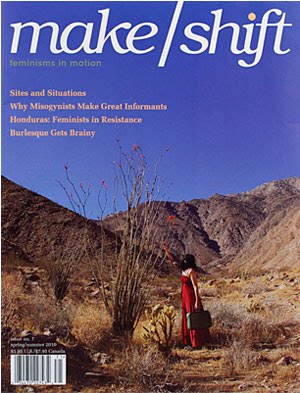 make/shift is a satisfying thing. Describing itself as "feminisms in motion," it is a much-needed breath of fresh air for both our minds and our movement. Deep, political roots give way to a body of thought-provoking content and are topped with flexible branches of ideas, encouraging discourse and change. The magazine itself has full-color front and back covers. The entire inside is in black and white. It's heavy on text, and I like it that way. The layout is easy to read; no "continued on page seven" nonsense here. Pictures are scant, but clear and artful. There are advertisements, and as expected for a feminist magazine, they're not of the demeaning garden-variety like the ones we see in other magazines.


