Showing posts with label narrative. Show all posts

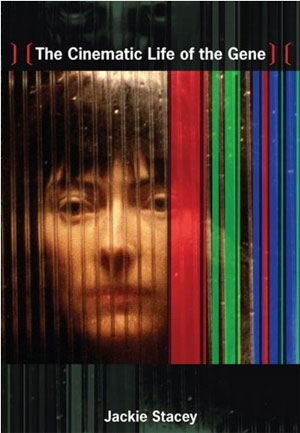
The Cinematic Life of the Gene

By Jackie Stacey
Duke University Press

The Cinematic Life of the Gene is a challenging and complex collection of essays that uses cinematic representations of genetics and cloning to consider the cultural impact of genetic breakthroughs. Jackie Stacey draws on some of the most well known theoretical works regarding cinema, art, and the body to consider the fascinating link between cinema and genomics. Her essays cite everything from feminist and psychoanalytic theory to theories of passing and reassemblage. It is the text's interdisciplinary nature that makes it both challenging and significant; cinema scholars, scientists, and feminists alike will find this work compelling. Still, The Cinematic Life of the Gene roots its examinations in the moving image, and serious scholars of the cinema (and particularly of science fiction cinema) will benefit from this “cultural study of film.”

Stacey’s work centers on an interesting premise: that cinema is uniquely tied to the science of cloning, since both are “technologies of imitation” which illustrate “a fascination with the boundary between life and death, and with the technical possibilities of animating the human body.” More than their fascinations with life and death, however, Stacey is interested in how scientific conceptions of cloning and genomics work concurrently with cinematic representations in creating “aestheticized forms of envisioning the human body.” In other words, scientists and filmmakers alike have visually codified genetic manipulation as a means of understanding and coping with its cultural and social ramifications. Stacey examines these attendant fears and desires surrounding genetic manipulation, referring to them as “the genetic imaginary,” a theoretical and cultural space in which “the fears and desires” around cloning and genomics are expressed and explored. She utilizes analyses of films from multiple genres (science fiction, the art-house thriller, feminist independent film, and body horror) to examine how fears surrounding genomics are expressed through both narrative and visual structure.

Stacey's explorations of the cultural impact of genomics on the psyche are fascinating but rather overwhelming, particularly because of her heavy dependence on prior theoretical works by the likes of Jean Baudrillard and Walter Benjamin. Unfortunately, Stacey focuses so heavily on explicating her predecessors’ works that she tends to obscure her own thoughts; her contributions to these theories get lost amongst the jargon of her theoretical ancestors. Stacey serves her reader well by anchoring her arguments in popular works like Gattaca and Alien: Resurrection, making her work more approachable and comprehensible. She succeeds when she pares down her writing and engages with fewer theoretical texts in an essay; for example, she provides an inspired and fascinating examination of feminine masquerade in the science fiction film, applying the theories of well-known feminists Luce Irigaray and Mary Ann Doane to constructions of men in narratives of cloning.

The Cinematic Life of the Gene is not for the novice cinema or science fiction scholar, but those seriously engaged in a cultural study of the moving image or genetics would serve themselves well to tackle it. Scholars aligned with feminist and queer theories will also find rich fodder for thought in Stacey’s attentions to feminism, gender, and sexuality on screen.

Review by Joanna Chlebus

Unfastened: Globality and Asian North American Narratives

By Eleanor Ty
University Of Minnesota Press

In a similar vein as Caroline Rody’s The Interethnic Imagination and Rocío Davis' Begin Here, the monograph Unfastened has been a treat to read for the simple fact that author Eleanor Ty forefronts a wide range of readings that demonstrate the continued evidence of the heterogeneity that embodies the field of Asian North American literature. Ty’s book is called unfastened, precisely because it is a descriptive that designates the continuing complexity that has been emerging with the textual terrains around concepts of mobility, displacement, and diaspora that make fastening Asian North American literature to any one place practically impossible.

In the primary texts that Ty so elegantly analyzes, multiple nations, multiple local spaces, and multiple subjectivities are always imagined, such that her readings flow contextually, specific to particular aesthetic forms and contexts, but always linked by the notion of “globality.” Ty is careful about her terminology. She purposefully does not use the term Asian American precisely because she carves out a specific place for Asian Canadian cultural production in her work, which has had a long history of being too reductively classified within Asian American more broadly.

She also distinguishes globality from the globalization, rendering globality the more salient feature of her critical reading practice precisely because it is more connected to issues of economic differentials and power inequities that arise as bodies, cultures, ideas, technologies, etc. migrate to new locations and establish new spatial configurations. As Ty clarifies, “Issues of globality include concern for earth and our environment, health and the spread of disease across national borders, the globalization of markets, and the production of goods.”

The wide range of primary text readings are truly astonishing and we see what a fan of Asian North American narrative Ty is as she meticulously crafts her analyses to continually point to the ways that Asian North American writers are thinking about globality and routing that issue directly within their textual terrains. Taken together, Ty concentrates on Brian Roley’s American Son, Han Ong’s Fixer Chao, Larissa Lai’s Salt Fish Girl, Hiromi Goto’s The Kappa Child, Ruth Ozeki’s All Over Creation, Chitra Banerjee Divakaruni’s The Mistress of Spices, Sunil Kuruvilla’s Rice Boy, and Lydia Kwa’s This Place Called Absence, among others. Many of these authors are ones that have received very little critical attention, even though their works present such rich terrains upon which to consider the complexities of globalization.

While all the chapters provide sprightly interpretative readings in which texts cannot be fastened within one context or sociocultural moment, some standouts include chapter two’s “Recuperating Wretched Lives: Asian Sex Workers and the Underside of Nation Building” and chapter five’s “Shape-shifters and Disciplined Bodies: Feminist Tactics, Science Fiction, and Fantasy.” Given the astonishing range of writings being produced, Ty’s conclusion offers a corrective to the concept of Asian American literature, offering that the rubric of “global novelist and global writing are more accurate for terms and for works,” especially with respect to the increasingly non-domestic contexts of many narratives.

Ty leaves us then with the concept of the “Asian global,” conceptualized in part because such narratives “arise out of and are contingent upon globalization—the movement of people, capital, and production across the north and south—and because they are no longer located just in North America or Britain.” In ending this brief review, it would seem the possibility that Ty is pushing for a potentially new field rubric in which Asian global texts written in English appear front and center. In this way, the move to diasporic and transnational critiques which typically and traditionally have not shifted beyond a two-country paradigm can be supplanted with this Asian global literary studies model that pushes scholars to contextualize texts from multi-focal spatial axes.

Review by Stephen Hong Sohn

Cross-posted at Asian American Literature Fans