Showing posts with label critical theory. Show all posts

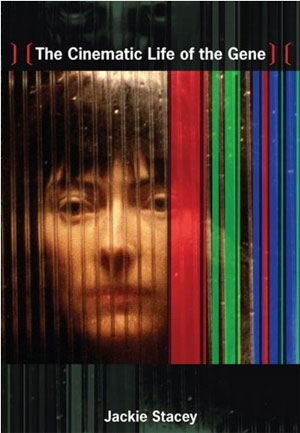
The Cinematic Life of the Gene

By Jackie Stacey
Duke University Press

The Cinematic Life of the Gene is a challenging and complex collection of essays that uses cinematic representations of genetics and cloning to consider the cultural impact of genetic breakthroughs. Jackie Stacey draws on some of the most well known theoretical works regarding cinema, art, and the body to consider the fascinating link between cinema and genomics. Her essays cite everything from feminist and psychoanalytic theory to theories of passing and reassemblage. It is the text's interdisciplinary nature that makes it both challenging and significant; cinema scholars, scientists, and feminists alike will find this work compelling. Still, The Cinematic Life of the Gene roots its examinations in the moving image, and serious scholars of the cinema (and particularly of science fiction cinema) will benefit from this “cultural study of film.”

Stacey’s work centers on an interesting premise: that cinema is uniquely tied to the science of cloning, since both are “technologies of imitation” which illustrate “a fascination with the boundary between life and death, and with the technical possibilities of animating the human body.” More than their fascinations with life and death, however, Stacey is interested in how scientific conceptions of cloning and genomics work concurrently with cinematic representations in creating “aestheticized forms of envisioning the human body.” In other words, scientists and filmmakers alike have visually codified genetic manipulation as a means of understanding and coping with its cultural and social ramifications. Stacey examines these attendant fears and desires surrounding genetic manipulation, referring to them as “the genetic imaginary,” a theoretical and cultural space in which “the fears and desires” around cloning and genomics are expressed and explored. She utilizes analyses of films from multiple genres (science fiction, the art-house thriller, feminist independent film, and body horror) to examine how fears surrounding genomics are expressed through both narrative and visual structure.

Stacey's explorations of the cultural impact of genomics on the psyche are fascinating but rather overwhelming, particularly because of her heavy dependence on prior theoretical works by the likes of Jean Baudrillard and Walter Benjamin. Unfortunately, Stacey focuses so heavily on explicating her predecessors’ works that she tends to obscure her own thoughts; her contributions to these theories get lost amongst the jargon of her theoretical ancestors. Stacey serves her reader well by anchoring her arguments in popular works like Gattaca and Alien: Resurrection, making her work more approachable and comprehensible. She succeeds when she pares down her writing and engages with fewer theoretical texts in an essay; for example, she provides an inspired and fascinating examination of feminine masquerade in the science fiction film, applying the theories of well-known feminists Luce Irigaray and Mary Ann Doane to constructions of men in narratives of cloning.

The Cinematic Life of the Gene is not for the novice cinema or science fiction scholar, but those seriously engaged in a cultural study of the moving image or genetics would serve themselves well to tackle it. Scholars aligned with feminist and queer theories will also find rich fodder for thought in Stacey’s attentions to feminism, gender, and sexuality on screen.

Review by Joanna Chlebus

Can the Subaltern Speak?: Reflections on the History of an Idea

Edited by Rosalind C. Morris
Columbia University Press

I was first introduced to Gayatri Chakravorty Spivak’s famous 1988 essay, “Can the Subaltern Speak?” during a graduate seminar that focused on postcolonial and feminist literature. While I read many works by various important and transformative authors during that semester, Spivak’s discussion of the subaltern stood out to me as being more important and more transformative than the others. To be honest, there are portions of the essay that I still don’t understand; there are analogies and culturally based references that elude me.

However, the ideas that I took away from Spivak’s essay were powerful and thought-provoking because they allowed me to think about a group of women, whom Spivak calls the “subproletariat subaltern,” in a manner that allowed me to connect with these women. Specifically, Spivak’s interwoven application of Marxist, deconstructionist, feminist, and postcolonial theories allowed me to understand the capitalist system in which I—a middle class, white, woman born and raised in America—navigate, at times successfully and at others with great disappointment.

To an ever greater extent, Spivak’s assertions in “Can the Subaltern Speak?” made it clear to me that this is the same system which has worked to imprison a certain global class of women, specifically in formerly colonized nations. While women of all socioeconomic statuses and ethnic backgrounds have suffered under the cruel grasp of capitalism, Spivak’s detailed analysis of the international division of labor and the global market-based economy shows that subproletariat women have suffered the most. As a subaltern group, they have had few to no opportunities to be heard, much less to speak.

In this newest anthology, Can the Subaltern Speak?: Reflections on the History of an Idea, various scholars and authors have written essays in response to Spivak’s essay. The topics of these essays include research and pedagogy, the human rights of indigenous women in Guatemala and Mexico, slavery in the United States, and the interpretation of World War I in a postcolonial context. The diversity of these responsive essays shows the impact and far-reaching implications of Spviak’s original essay. Also included in this anthology is an Introduction by Rosalind C. Morris and an Afterword by Spivak, in which the author discusses the original essay’s past and future.

This is a not a light summer read. If you are interested in postcolonial theory and found Spviak’s original essay to be of value, as I and many others have, then this collection of essays is worth reading. Scholars and teachers of critical theory would find no shortage of material to discuss, evaluate, and consider. This text is not one that you sit down and read in an entire afternoon. Instead, it is a collection of ideas that you can revisit time and again. The sentiments discussed by Spivak and the other authors are especially poignant now because of the strife in the global economy, international warring, and the increased stratification of the classes. I suspect, sadly, that these sentiments will be relevant for years to come.

Review by Rachel Scheib

Stance: Ideas about Emotion, Style, and Meaning for the Study of Expressive Culture

By Harris M. Berger
Wesleyan University Press

My critical theory class from university seemed far away when I started reading Harris M. Berger’s study, Stance. In that course, Reception Theory was probably the most difficult one to grasp, with the most theoretically abstract readings, readings for the most part founded in philosophy. Realistically, the world does not know enough about the brain or perception, and cultural context varies considerably from person to person. Joe can like or dislike something but Jane’s tastes are different; subjectivity is the key to this experience, and thus Berger is attempting to explain a very complex phenomenon. To look at subjectivity through reason, what Berger is attempting to do, seems a daunting task.

Harris M. Berger approaches these questions with gusto, however, and for that I must give him credit. His grasp of key intellectuals and their theories are evident in the text. The purpose of his analysis is to explore the larger issues associated with a person‘s “lived experience,” of diverse phenomenon, and especially music. Music is central to Berger’s work as a professor of music and performance studies in Texas.

Luckily for readers, the author is not just diligent about defining the terms he uses but also writes with acuity and finesse. For example, for him “stance is the manner in which the person grapples with a text, performance, practice, or item of expressive culture to bring it into experience.” Stance is a much more elegant word than posture, position or interpretation but all three refer to the work that is done in the reception of an occurrence. Berger is also generous with examples in an attempt to contextualize some of the more complicated passages. The narration of some of his own experiences is quite fascinating, and the first-person perspective, although it contrasts with the very formal philosophical discussion, alleviates our experience of the book.

A word of warning: I believe that Berger’s study would be almost impenetrable to someone who is not an academic (or very well versed in philosophy) because of its philosophical nature and Berger’s phenomenological approach. For neophytes, phenomenology is defined by the Oxford English Dictionary as “an approach that concentrates on the study of consciousness and the objects of direct experience.” For this reason, Berger’s book needs to be read with leisure and much concentration. However, if one is willing to make the effort, Berger’s study contains many insights into the multifaceted nature of what Berger calls the “lived experience.”

Review by Sophie M. Lavoie

Encarnación: Illness and Body Politics in Chicana Feminist Literature

By Suzanne Bost
Fordham University Press

The pockmarks on the Aztec figure on the cover of Suzanne Bost’s Encarnación: Illness and Body Politics in Chicana Feminist Literature are a reminder of the proximity of disease, illness, and pain to death. Chicana artist Maya González’ painting is in fact entitled Death Enthroned, and serves as a constant thematic backdrop to Bost’s book since it embodies many of the themes that Bost will deal with in her study of Chicana feminist literature: Aztec culture, illness, death, religion, and woman’s precarious position in the intersection of these elements.

Bost’s study is not the first to examine Chicana feminist literature, as many readers will note (many such studies have been reviewed by FR). In effect, the three authors Bost chooses to analyse are part of the established cannon of Chicana literature, with Gloria Anzaldúa being the face of said literature with twice as many critical articles written on her (over 200 in the MLA directory as of April 1, 2010). Both of the other writers, Cherríe Moraga and Ana Castillo, have also established themselves in the last twenty years or so. All three have been studied within other “literary labels,” such as Queer Studies for Cherríe Moraga and Ecocriticism for Ana Castillo, for example.

Separately, all three authors have been examined under the relatively new label of Disability Studies, but the intersection of Disability Studies with Chicana Feminist Literary Studies is a novelty, which Bost (and other academics) sees as appealing. In the contextualization of her analysis, Bost finds it fitting to differentiate studies on the Female Body (which have been done for each of the writers mentioned) with Disability. This is perhaps one of the most interesting theoretical parts of her analysis since the line separating the two is very fine: pain, illness, and disability are all part of the bodily construction and seem inseparable. Thus, Bost’s analysis is enlightening as to what exactly is new in her approach: a Chicana identity rooted in the body, but which transcends it, as her use of the Spanish term encarnación (incarnation) in the title signals both a figurative and literal embodiment. Bost specifically writes that she is interested in “the ways in which other corporeal qualities—ones that are not genetic, visible, or already politically inscribed as an assumed axis of oppression/privilege—upend the familiar forms of identity.”

Before moving to individual chapters examining each author, Bost explores the context of identity and grounds Chicana identity in the Aztec traditions. The author is very thorough in her reminder of all the Aztec symbolism throughout the four chapters and, for those of us who need a refresher, there is an abundance of useful information. What Bost terms as a hagiographic (reverential towards the religious figures) study of Aztec culture is also useful in that it establishes an unconventional (read non-Christian) relationship to pain, illness, death, and their relationship to representation in that tradition. Furthermore, in this chapter Bost chooses to iconize Frida Kahlo as one of the central contextualizing figures for the Chicana disability studies as she epitomizes both analytical elements, as well as being a significant influence on all three authors.

All three chapters on the individual authors are well written and quite detailed. However, one can but lament the fact that Bost did not take the opportunity to write a proper conclusion to her study (one that would have reiterated the more direct links between the writers and come to some consensus about the use of Disability Studies as a useful tool to examine Chicana Feminist Literature). Although I personally find her introduction of the Chicana artists Maya González and Diane Gamboa in her conclusion to be fascinating and informative, it is Chicana Feminist Literature that her study chooses to focus on, and it would have been interesting to see if Bost had found relevant links to other Chicana writers. With the prominence of the Chicana women artists and the inclusion of the twelve beautiful color plates in her book, it is almost fitting to suggest that the book be renamed Encarnación: Illness and Body Politics in Chicana Feminist Representation.

Review by Sophie M. Lavoie