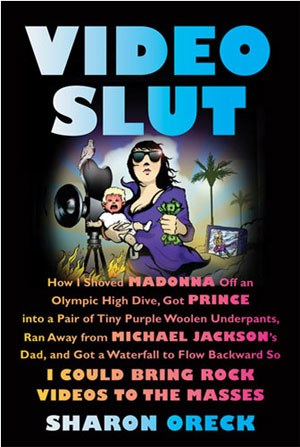
Sharon Oreck has the career that any child of the ‘80s would envy. She has produced over 600 music videos, many of which defined the monolithic “MTV generation.” She has been nominated for Oscars, Grammys, Women in Film awards, and of course, MTV Music Awards (twenty total!). From 1984 to 2000, Oreck’s work was a model for the visual repertoire that shaped the collective imagination of teens around the globe. Her role in popular culture is so far-reaching that she has been included in a film alongside such figures as Hillary Rodham Clinton (14 Women).
The majority of Oreck’s memoir relates events that occurred while shooting Sheila E.’s "The Glamorous Life," Aha’s "Take on Me," Madonna’s "Like a Prayer," and my personal favorite, Chris Isaak’s "Wicked Game." Upon viewing the videos, Oreck’s talent is immediately obvious. But what was she thinking when she was shooting? Apparently, she was thinking about a lot.
Reproductive rights, feminism, beauty—these are just a few of the topics that Oreck contemplates in Video Slut. Her most empowering moments as a writer occur during the introspective climax, which pairs her decision as a pregnant teen to keep her baby with the demise of her first production company, NO Pictures.
Oreck’s book is written in a tips-from-your-cool-older-sister style. Oreck spares no details and even offers pointers for making it in the scantily clad rock video world—most importantly, don’t make fun of executives until after they’ve left the room. More notably, this narrative updates the classic format for celebrity memoirs by exchanging the contexts of alternating chapters between a video career and an early pregnancy at sixteen. Video Slut puts the spotlight on the largely undocumented moments during video’s heyday—overqualified assistants, moonlighting pot dealers, egotistical bigwigs, and pop stars are the mediums through which Oreck relates her professional and personal milestones.
This is one of the most likable new books that I have read, and I look forward to more of Oreck’s outstanding work; her experiences combine elements of after-hours stand-up comedy, frank confessionals, and visionary strategies for survival when the odds don’t look so good. After all, that’s what petty cash is for, right?
I love a romantic comedy. Throw in some magic realism–even better. Jac Schaeffer's Timer ticks both of those boxes, but, unfortunately for a film that explores people’s fears about missed opportunities, this film missed a few opportunities itself, and lost me as a fan in the process. (It bills itself as sci-fi but I say magic realism–there is new technology, but it’s never fully explained. I call that magic. More on this later, though.)
The concept is great: a company has created a wrist implant that counts down to the moment you will meet your soul mate–but only if that person has also bought an implant from the company. Obviously, this service is incredibly popular, leading to new phenomena in the dating world: some desperate types insisting every new person they date gets a timer implanted to make sure they’re "the one," others only dating those with timers in the first place, last-hurrah flings as the timer counts down its final days, and even technophobic hold-outs who don’t trust this newfangled stuff (with parallels to social networking). The consequences of having the timers could have been explored further though. Things were briefly touched upon-class issues, young love, bigger questions about fate and chance. The ideas all had loads of potential, but as I watched, I kept feeling like Schaeffer tried to go too far down each road, without taking the opportunity to wrap up every angle.
Because of all of the above, including my desire for more closure, I really wanted to like this film, and came very close to liking it. A few other things rankled, though. This may seem petty, but it struck a nerve with me: One of the opening shots of the film was of the logo of the company that created the timers–the silhouettes of a man and a woman, yet we briefly see later in the film that the company caters to couples of all sexualities. I don’t generally care what sexualities the main characters of a romantic comedy are, but it wouldn’t have taken much more effort to come up with a logo that was slightly less heteronormative. I mean, surely it would have been better advertising for the company itself within the confines of the film.
Which brings me back to the world of the film. It was quite shallow–poke at it too hard and it was clear that there were a lot of unanswered questions: How did the technology work? How did the implants work? Why hadn’t anyone tried to hack the system? What if people’s bodies rejected the devices? Were they only available to wealthy westerners? Again, what made for a less than satisfying film could yet pave the way for a great series.
When it comes to the Bechdel Test, this film almost succeeds, but focuses just too hard on the guy-chasing and glosses over the other aspects of the relationship between the two main characters. Timer’s website purports to put across the message that you can escape your fate, but the message I got was these women needed to define themselves through their romantic relationships.
It may seem quite an impossibility, but the film Leading Ladies is, simply put, a quietly revolutionary dance musical. While most dance musicals (think Dirty Dancing, Save the Last Dance) center on the boy-meets-girl heterosexual love match, Leading Ladies is a beautifully wrought girl-meets-girl story. It is simultaneously a dance musical, coming-of-age story, and coming-out narrative. The power of the film comes from its ability to maintain the generic conventions of the story while completely rejecting the hetero-normativity that is typically the narrative thrust of the genre. What’s perhaps even more amazing is that Leading Ladies succeeds at thwarting convention within a conventional structure while simultaneously being a whole lot of damn fun. Lesser films would sink under such weight.
Helmed by first-time directors Erika Randall Beahm and Daniel Beahm, this joyous film tells the story of the Campari women. The matriarch of the family is ballroom-dancing stage mom Sheri, played by Latin and Ballroom Champion Melanie LaPatin. Sheri has two daughters: like-minded drama queen and dancing champion Tasi (Shannon Lea Smith), and Toni (Laurel Vail), Tasi’s practice partner and the wallflower of the family. The film centers on Toni’s relationships, particularly with the emotionally volatile Tasi, and an unexpected romantic attachment to Mona (Nicole Dionne), a bubbly and outgoing woman Toni meets at a dance club. While LaPatin’s acting is a bit stiff, Smith’s neurotic and self-obsessed Tasi is played to high-pitched perfection. Vail might be the real star of this film, however, as she says more with her eyes than many actors can express with a word. She artfully plays the Ugly Duckling, the quiet witness to familial squabbles and the glue that keeps the Camparis together.
Leading Ladies has an ebb-and-flow, alternating between slow and quietly stirring scenes and vibrant, fast-paced dance numbers (most notably a hysterical and boisterous number set in a grocery store). The heart of this film beats loudly and quickly, and it leaves the viewer invigorated and deeply moved. To learn more about her hopes for the film, its generative process, and the ideological concerns that lead to its creation, I recently spoke with co-director Erika Randall Beahm.
Beahm co-wrote the film with Jennifer Bechtel, a friend and LGBT youth advocate in Champaign, Illinois, and Bechtel was struggling to find mainstream films that spoke to the young gay community. As Bechtel and Beahm perceived it, most gay and lesbian cinema tends towards violence or explicitness, while mainstream cinema features gay characters as “the sidekick.” Beahm and Bechtel thus sought to create a “family-centered gay and lesbian film for the mainstream market.” Their hope is that Leading Ladies provides gay youth with a positive portrayal of gay romantic love and thus “open a dialogue within themselves” and perhaps between gay youth and their families.
The film eschews aggressive and explicit representations of gay love for a romantic and “joyful falling in love which... straight kids get to experience in movies all the time.” Indeed, Leading Ladies treats its same-sex couple as any movie musicals’ heterosexual pairing: they meet, they dance, they fall in love. The romance is beautifully articulated through an artful juxtaposition of two dance sequences. Toni and Mona’s meeting is shot like a typical dance movie sequence—bright lights, loud music, and overhead shots looking down on the dancers. This film could be Dirty Dancing, if it weren’t for the same-sex couples dancing on stage and in the audience. Indeed, this is the goal of the film: to illustrate that dance (and by extension, romance and love) is the same for same-sex couples as it is for heterosexual partners. Toni leads Mona through a raucous, enthusiastic dance, and as convention dictates, the two find love while dancing. In a beautiful inversion of this sequence, we next find Toni in Mona’s lush apartment, where the more romantically experienced Mona takes the lead in the dance of romance. The lovers’ embrace is gorgeously shot in sensual blush tones and shadow.
For choreographer and dancer Beahm and youth musical programmer Bechtel, dance served as an obvious choice of backdrop for the love story. Beahm choreographed the film’s dances with Melanie LaPatin and Benji Schwimmer, the former So You Think You Can Dance! winner who also plays Toni’s best friend in the film. For Beahm, dance has an inherently transformative power: “There’s this kind of kinesthesia with dance that gets people to literally be moved on a physical level, and I believe also on an emotional and intellectual level.” The love scene between Mona and Toni, for example, is highly choreographed to match the non-diegetic music; Beahm suggests that this emphasis on “energy shifts… and the musicality” of the scene helps the spectator “lose sight of this being a gendered duet, and it just becomes two people moving together, falling in love.”
By emphasizing the movement and musicality of the scene, then, Beahm hopes to ease the fear of spectators who are uncomfortable with same-sex coupling and perhaps open a space for internal dialogue within the spectator: “For people who might have a hard time seeing two women... make out, it becomes this kind of transference of two bodies going through these really emotional and tender but also choreographed spaces, and so gender becomes less important.” By shifting the spectator’s focus from gender distinction to the movement of the body the film illustrates how little gender matters and how love—like dance—is a universal language. Thus the film utilizes dance to open up a space for shifting “people out of the fear they may feel if they’re watching from an outside perspective.”
Though the idea of dance as a catalyst to ideological and personal transformation may seem unusual, Beahm is quick to point out that dance has often added a “queer element” to the movie musical. In West Side Story, for example, the spectator sees groups of men “snapping and skipping” and yet the dance isn’t “sexualized, it’s charged and it’s activated.” Dancing is particularly subversive in moments of unison dancing, she suggests, when members of both sexes dance the same movements, suggesting a unity of the sexes and the democratization of the body. Leading Ladies takes this democratization one step further, rejecting the hetero-normative ballroom dance structure of male lead and female follow and replacing it with same-sex couplings. In doing so, Beahm simultaneously feeds off of the democratizing nature of dance while rejecting the rules of a dance form that reinforces gendered performance.
It is the inherent queerness in dance that Beahm finds so appealing and in tune with her views on feminism. For her, dance and feminism are “compatible” because they are both “hard to pin down” terms; their “slipperiness” as terms allows them to create spaces for dialogue and questioning. She likes her feminism to work “from the inside out,” enjoying the notion of becoming part of a system, and breaking it down from within. This is why her personal mantra is the cheeky suggestion to “wear pearls to the country club and then talk dirty.” Ultimately, Leading Ladies represents a filmic expression of this mantra—by placing non-conventional characters within a conventional generic structure, the film wears its pearls but then lets out a glorious, enthusiastic expletive as it sits down to dinner. Swearing has never been so much fun.
By Mark Garrett Cooper University of Illinois Press
In Universal Women, Professor Cooper launches a multi-disciplinary investigation into the mystery of why it was that Universal Film Manufacturing Company broadly supported women directors during the 1910s before abruptly reversing the policy. Drawing on philosophical, sociological, historical and structuralist interpretations of gender, culture, power, and institutions, Cooper’s study is positioned to show the interrelationship between art and the development of social norms, aesthetics, and political upheaval, and culture and epistemology in the United States.
However, readers looking for a narrative account of women director’s success and subsequent exile from Universal should look elsewhere. Cooper sets up his project by describing a confluence of events and personalities, some of which appear to be only distantly related, that played varying roles in this drama of gender. Some of these are not clearly explained, as when Professor Cooper explains the etymology of a word but does not clearly tie his explanation to the relationship he is trying to describe and defend.
His definitions and explanations take the following pattern: first, Cooper defines a word like “institution” or “organization” with an appeal to the Oxford English Dictionary. He appeals to the historical use of words to explore the concepts that fall under the definition and to point to a kind of etymological necessity: the word organization brings with it an inheritance from biology and so organizations are implicitly naturalized. Then he describes the word in its social development and practical usage. In the case of “organization” Cooper describes different sociological invocations of the word-concept.
Although in the next section, Professor Cooper describes the bi-coastal organization of Universal Film Manufacturing Company, he does not tie this historical description to the linguistic, historical and sociological discussion that preceded it. It seems that the reader is meant to intuit his purposes in such places and to develop the claims herself. I am not opposed to writing styles that foster critical thinking. But Cooper doesn’t make clear his purposes in so defining and explaining (for example). That is to say, I can look up definitions. I have access to the OED. I can read Durkheim and Weber. But I can’t get inside Cooper’s head to figure out what it is he intends by these things.
Reading Cooper’s book is a bit like watching someone’s film depicting a movie being made: it is interesting to see all the “extras” around the set–the camera crew, the lighting, the onlookers, the caterers, the director and producers and the landscape behind the backdrops and facades–but it is difficult to follow the plot of the movie being made.
The book is directed toward an academic audience; readers should be advised to plant their pinkies in the endnotes for quick reference. It will be most intelligible to those trained in film studies or who are such avid consumers of early Hollywood films and trivia that the characters are familiar–I had a hard time keeping track of names. The study is an interesting one, stressing the role that Universal played in interpreting and then enforcing what it means to be gendered as a man or as a woman. It would be interesting to see a slightly more narrative treatment of the subject–even a narrative that made clear the difficulties of narrative for such a diffuse phenomenon as the shifting meanings of gender–in order to appeal to more non-specialists.


 By Sharon Oreck


